If accuracy is your priority, DEXA scans are the clear winner. They measure body composition directly using low-dose X-rays, offering precise results with an error margin of ±0.5% to ±1%. In contrast, body fat scales use electrical signals to estimate composition and have a wider error range of ±3% to ±10%. This means DEXA scans can detect even small changes in fat, muscle, and bone density, while scales are more prone to inconsistencies due to factors like hydration or recent meals.
| Feature | DEXA Scan | Body Fat Scale (BIA) |
|---|---|---|
| Accuracy | ±0.5% to ±1% | ±3% to ±10% |
| Measures | Fat, muscle, bone | Fat (estimated) |
| Visceral Fat | Yes | No |
| Cost | $100–$250 per scan | $20–$150 per scan |
| Hydration Impact | Minimal | High |
| Convenience | Requires facility visit | At-home use |
Choose DEXA for precision and detailed insights. Opt for body fat scales if you need a quick, affordable way to track trends over time, or compare other body composition testing methods to find the best fit for your goals.
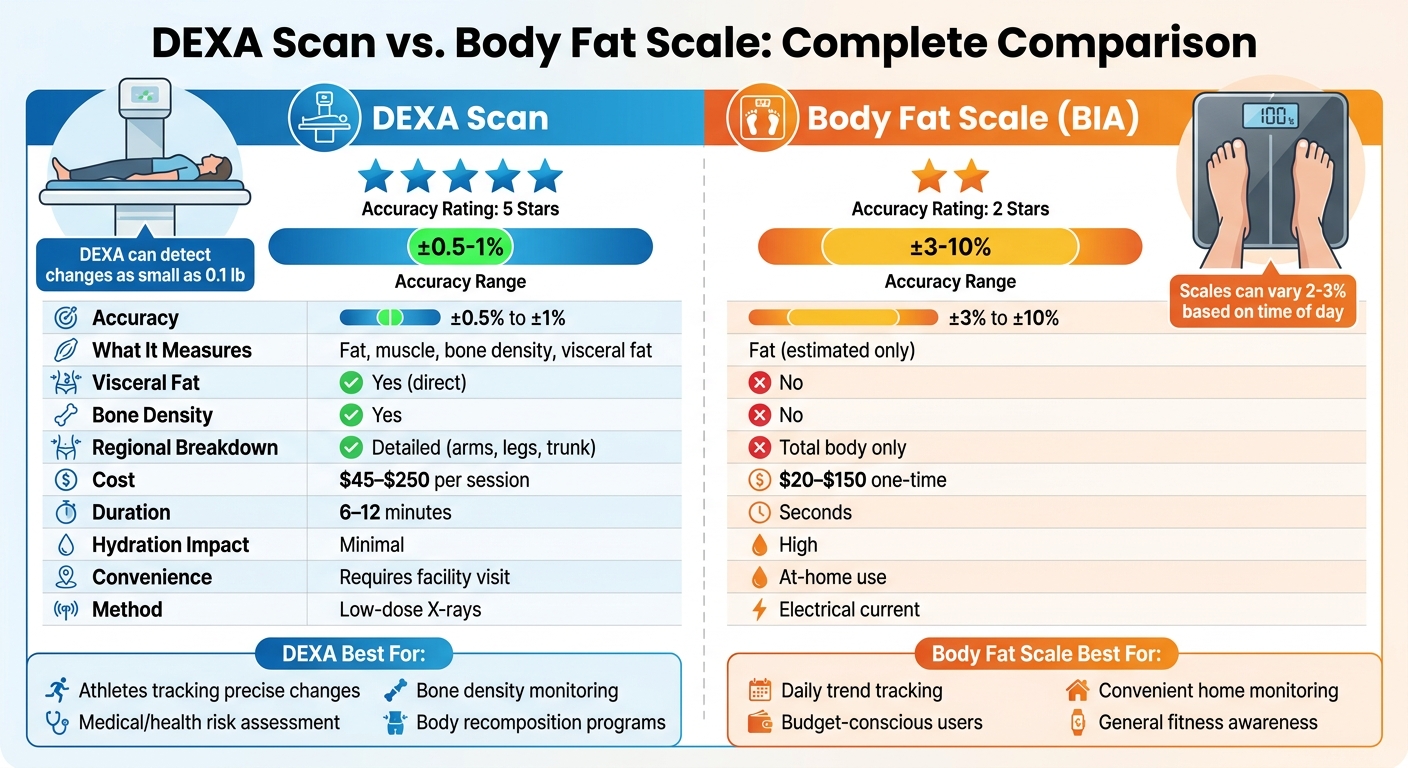
DEXA Scan vs Body Fat Scale Accuracy Comparison Chart
Dual-Energy X-ray Absorptiometry (DEXA) works by using two X-ray beams - one high-energy and one low-energy - to differentiate tissues based on how they absorb the beams. Bones, being dense, block the low-energy beam the most. Lean tissue, which includes muscles, organs, and water, shows a moderate level of absorption, while fat absorbs both beams in a similar way. This allows DEXA to break the body into three distinct components: fat mass, lean mass, and bone mineral content.
"DEXA's two energy beams can precisely identify tissue types that would look identical to a single-energy system."
During the scan, the scanner arm moves slowly across your body, capturing thousands of data points, or pixels, from head to toe. Each pixel is analyzed for its absorption characteristics and categorized into fat, muscle, or bone. This pixel-by-pixel mapping builds a detailed picture of your body's composition without relying on generic population data.
DEXA also measures visceral fat - the fat around internal organs - which many other methods overlook. It even breaks down fat distribution by region, such as arms, legs, and trunk, and distinguishes between abdominal (android) and hip/thigh (gynoid) fat. Despite its advanced capabilities, the radiation exposure is minimal, about 0.001 mSv, which is significantly lower than a standard chest X-ray.
The scan is straightforward. You lie on an open table wearing non-metallic clothing to avoid interference. The process takes about 6 to 12 minutes. While no special preparation is required, some facilities suggest avoiding solid food for 4 hours before the scan and skipping intense exercise for 12 hours prior. Once the scan is complete, advanced algorithms calculate tissue mass pixel by pixel, generating a detailed report of your body's composition.
Body fat scales operate using Bioelectrical Impedance Analysis (BIA), a method that sends a low-level electrical signal through your body when you step onto the scale. This current, which you won’t feel, moves up one leg and down the other. As it travels, the scale measures how much the current slows down, a property called resistance or impedance.
Different tissues in the body interact with electricity in unique ways. Muscle and blood, which are rich in water and electrolytes, conduct electricity efficiently and show low resistance. On the other hand, fat and bone, with their lower water content, resist the current more. The scale uses this resistance data, combined with personal details you input - like age, height, gender, and weight - to estimate metrics such as body fat percentage, muscle mass, and sometimes even bone density through its algorithms.
Most standard scales only measure the lower body since the electrical signal doesn’t reach the upper body. This can lead to inaccuracies, especially for people who carry more fat in specific areas. To address this, advanced models use additional technology, like foot-to-hand systems or 8-electrode setups, to measure segments of the body such as arms, legs, and torso. Some high-end devices also utilize multiple electrical frequencies for more precise and detailed readings.
BIA readings are highly influenced by hydration levels. Since the technology depends on electrical signals traveling through body water, changes in hydration - whether from drinking fluids, consuming alcohol, eating salty foods, or hormonal shifts - can significantly impact results. For instance, dehydration increases resistance, making the scale show a higher body fat percentage, while overhydration lowers resistance, leading to a lower reading.
Certain activities can also affect readings. Intense exercise, especially from the day before, can alter water balance and circulation, misleading the scale. Similarly, activities like sauna sessions or hot yoga can cause temporary dehydration, skewing results. Even large meals can interfere by adding weight and changing conductivity.
| Factor | Impact on BIA Reading |
|---|---|
| Dehydration | Increases resistance; results in a higher body fat percentage |
| Overhydration | Decreases resistance; results in a lower body fat percentage |
| Recent Exercise | Alters water balance and circulation, leading to inaccurate readings |
| Food/Large Meals | Adds weight and changes conductivity, causing inconsistencies |
The quality of the scale also plays a big role in accuracy. Budget options, often priced around $30.99, usually rely on single-path, single-frequency measurements. Mid-range devices ($49.99 to $52.25) offer better consistency, while premium models - priced at $115.89 and above - incorporate multi-frequency, 8-electrode systems that deliver results closer to clinical standards. On average, most consumer scales fall within ±3 to 8 percentage points of DEXA scan results for body fat. However, a 2021 study revealed that some models could underestimate fat and muscle mass by as much as 17.6 lbs and 17.7 lbs, respectively, when compared to DEXA.
"The real question isn't whether your smart scale matches DEXA. It's whether the device you're using is engineered to be accurate, or engineered to be affordable." - Hume Health
While these factors can make precision challenging, the convenience of home monitoring keeps body fat scales widely popular.
Even though factors like hydration and recent activity can influence results, body fat scales are simple and accessible for at-home use. All you need to do is step on the scale, wait a few seconds, and receive your measurements. This ease of use makes them perfect for tracking trends over time. To get the most consistent results, it’s best to measure at the same time daily - ideally in the morning, after using the restroom but before eating or drinking. Always place the scale on a hard, flat surface, as carpets can interfere with the sensors, and ensure your feet are bare, dry, and properly positioned on the metal electrodes.
While body fat scales may not match DEXA scans for single measurements, they excel at identifying patterns over time. For example, a 2024 study of 6,990 users of an 8-sensor BIA device found that participants who weighed themselves at least three times a week could effectively monitor lean mass changes during GLP-1 therapy. The data revealed a mean lean mass loss of 16.9% of total weight lost - much lower than the 25 to 39% loss typically reported in clinical trials.
When it comes to precision, the difference between DEXA scans and body fat scales is striking. DEXA scans have a clinical error margin of ±0.8% to ±2%, whereas body fat scales using BIA (bioelectrical impedance analysis) technology are less precise, with margins typically ranging from ±3% to ±10%. To break this down: if your actual body fat percentage is 20%, a DEXA scan would likely report a range between 19.2% and 20.8%. In contrast, a BIA scale might show results anywhere from 15% to 25%.
This difference can have real-world implications. Sean Selters from Body Fat USA highlights the issue:
"A 3-5% margin of error (like with BIA) means you could lose 10 pounds of fat and not see it reflected in your results".
DEXA scans also excel in consistency. With proper preparation, their test-retest error margin is around ±0.5 percentage points, making them capable of detecting even small shifts in body composition.
But the advantages of DEXA go beyond just accuracy. Unlike BIA scales, DEXA scans measure bone mineral density and provide a direct estimate of visceral adipose tissue (VAT) - the fat stored around internal organs that poses significant health risks. Additionally, DEXA delivers a detailed regional breakdown of fat and muscle distribution, such as in the arms, legs, and trunk. In contrast, most body fat scales only offer a total body estimate.
| Feature | DEXA Scan | Body Fat Scale (BIA) |
|---|---|---|
| Accuracy (Error Margin) | ±0.8% to ±2% | ±3% to ±10% |
| Measurement Method | Direct tissue measurement (X-ray) | Estimation via electrical current |
| Bone Density | Yes (Directly measured) | No |
| Visceral Fat (VAT) | Yes (Direct estimation) | No (Algorithm-based estimate) |
| Regional Breakdown | Detailed (arms, legs, trunk, android/gynoid) | Usually none (total body only) |
| Hydration Impact | Minimal | High (can "trick" the scale) |
| Duration | 6–12 minutes | Seconds |
DEXA has earned its place as the "gold standard" for body composition analysis in clinical and research settings. Its accuracy closely matches the four-compartment (4C) model, the most advanced body composition method available, while being far more practical for regular use. This makes DEXA a popular choice among researchers and clinicians who need reliable results without the complexity and time demands of the 4C model.
Organizations like NASA rely on DEXA for monitoring astronaut bone health, and the Gatorade Sports Science Institute (GSSI) uses it for evaluating professional athletes. Plus, the radiation exposure from a DEXA scan is minimal - comparable to less than a single day's worth of natural background radiation. With its precision and versatility, DEXA remains a critical tool for in-depth body composition analysis.
Let’s dive deeper into the strengths and limitations of DEXA scans and body fat scales to better understand how they compare.
DEXA scans are known for their clinical-level accuracy, with an error margin of just ±0.5–1%. This precision allows them to detect even the smallest changes in body composition, such as a 0.1 lb difference or a 3-lb fat loss, which might otherwise go unnoticed with less precise methods.
Another standout feature is their ability to provide detailed diagnostics. DEXA scans measure visceral adipose tissue (VAT), bone density, and regional fat and muscle distribution. This level of detail is especially helpful for creating targeted health or fitness plans.
DEXA scans are also less influenced by short-term factors like hydration, meals, or recent exercise. Providers ensure accuracy by performing daily calibrations using "phantoms", maintaining consistent results over time.
On the other hand, body fat scales shine in their convenience and affordability. These devices offer quick, at-home results, making them ideal for frequent monitoring - whether daily or weekly. They also come at a fraction of the cost of DEXA scans, with prices ranging from $20 to $150 for a one-time purchase. In contrast, DEXA scans cost between $45 and $250 per session.
While they lack the diagnostic depth of DEXA scans, body fat scales are practical tools for tracking overall trends in body composition. However, it’s worth noting that they estimate body composition using algorithms rather than directly measuring tissue.
Both methods have their strengths, but they also come with limitations. Here’s how they compare:
| Limitation | DEXA Scan | Body Fat Scale (BIA) |
|---|---|---|
| Cost | $100–$250 per session | $20–$150 one-time purchase |
| Convenience | Requires a facility visit and a 6–10 minute appointment | Instant, at-home use |
| Hydration Sensitivity | Minimal impact | Varies by 2–3 percentage points based on time of day |
| Accuracy | High (±0.5–1% error) | Lower (±4–10% error) |
| Visceral Fat Measurement | Direct measurement | Estimated via algorithm |
| Bone Density | Included | Not available |
| Regional Data | Detailed breakdown by body region | Typically provides only a total body measurement |
| External Factors | Minimally affected by short-term changes; minimal preparation required | Highly affected by hydration, food intake, exercise, alcohol, and menstrual cycles |
Each method has its place depending on your goals, budget, and need for precision. While DEXA scans provide unmatched detail, body fat scales offer a practical and cost-effective way to track progress over time.
There are specific situations where a DEXA scan is the better choice, especially when precision and detailed insights are necessary.
If you're an athlete, bodybuilder, or working closely with a trainer, DEXA scans are ideal for tracking precise body composition changes. Unlike body fat scales, which can struggle to differentiate between muscle gain and fluid shifts, DEXA provides highly accurate measurements, making it perfect for monitoring nuanced progress.
For those focused on health and longevity, DEXA offers medical-grade data that goes beyond just body fat. It measures bone mineral density (BMD), providing T-scores and Z-scores to identify risks for conditions like osteopenia and osteoporosis before fractures occur. This becomes increasingly important with age, as it allows for early intervention and preventative strategies.
When assessing metabolic risks, DEXA is unmatched. It directly measures visceral fat (VAT), which is linked to serious health issues like diabetes, heart disease, and inflammation. Body fat scales rely on algorithms that often lack accuracy, while DEXA delivers precise data. Research indicates that elevated health risks begin when VAT reaches 100–160 cm², making this level of detail critical for managing and reducing risk.
If you're undergoing body recomposition - whether through strength training or fat loss programs - DEXA scans provide a clear picture of where weight changes are happening. For instance, a 3-lb fat loss could be obscured by the ±5% error margin of a body fat scale, but DEXA captures these changes with clarity.
Benchmark Body Metrics specializes in clinical-grade DEXA scans, offering detailed insights into fat, muscle, bone density, and visceral fat. Their services are HSA/FSA eligible, and results are delivered instantly alongside professional consultations. To track meaningful changes, most experts recommend scheduling a scan every 3–4 months.
When it comes to measuring body composition, DEXA scans set the gold standard. With the ability to detect changes as small as 0.1 lb and an error margin of just ±0.5–1%, DEXA leaves consumer body fat scales - whose error ranges from ±3% to 10% - far behind in terms of precision. This level of accuracy is essential for making informed, health-focused decisions.
What makes DEXA stand out is its method: it uses low-dose X-rays to directly measure body tissues. In contrast, body fat scales rely on electrical impedance, which can be thrown off by factors like hydration levels, recent meals, or physical activity. Beyond tracking progress, DEXA provides insights that scales simply can't, including visceral fat levels, bone mineral density, and regional muscle distribution. This makes it an invaluable tool for those serious about understanding their body and health.
It’s typically suggested to schedule a DEXA scan every three to six months. This interval strikes a good balance - it gives your body enough time to show measurable changes in composition while allowing you to keep an eye on your progress and stay aligned with your health goals.
To get more consistent and reliable measurements, control the factors that can impact accuracy. Here’s how:
Following these steps can help minimize variations and provide more dependable results over time.
The radiation exposure from a DEXA scan is extremely low and is typically deemed safe for most people. It uses a small amount of ionizing radiation, similar to what you'd experience with standard X-rays. This low level of exposure makes it a dependable choice for assessing body composition with very little risk.


.svg)
