Want to ace your first VO2 max test? Here’s what you need to know.
A VO2 max test measures how efficiently your body uses oxygen during intense exercise, offering insights into your fitness level and cardiovascular health. It’s helpful for athletes, fitness enthusiasts, and anyone tracking their health. Lab tests are the most accurate option, costing $150–$250 in the U.S., and provide more reliable data than fitness trackers.
To prepare:
On test day, expect a warm-up, a graded exercise phase, and a cool-down. Your results will help tailor your training and track progress over time. Regular testing every 3–6 months can provide a clear picture of your fitness journey.
Pro tip: Consistency in preparation and testing methods ensures reliable comparisons.

VO2 Max Test Preparation Timeline: 48 Hours to Test Day
The two days leading up to your test play a big role in ensuring accurate results. Here's how to get yourself ready to perform at your best.
Take it easy on your body during this time. Skip any intense workouts like HIIT, long-distance running, or anything that leaves you with sore muscles or high lactate levels. As Tyler Read, BSc, CPT, points out:
"When you surpass your VO2 max during cardio exercise, your body begins using anaerobic energy systems, which are much quicker to fatigue and cause a buildup of lactate in your muscles."
Instead, opt for light activities such as a gentle walk or full rest. And if you’re planning to retest in the future, stick to the same pre-test routine each time. This consistency helps ensure your results accurately track your progress.
Once your activity is sorted, focus on fueling your body.
What you eat can make a big difference. Prioritize meals rich in carbohydrates and protein to keep your glycogen stores full - these are your muscles' main energy source during intense exercise.
Avoid alcohol and caffeine for 24–48 hours before the test. Why? Both can mess with hydration, heart rate, and oxygen use, which could throw off your results. As VO2 Master explains:
"Caffeine and alcohol can influence heart rate and oxygen consumption, leading to inaccurate readings."
Also, avoid heavy meals within two hours of your test to prevent any stomach discomfort. Stick to moderate portions to keep your energy levels steady.
Now, let’s talk about hydration.
Hydration is key to performing well. Dehydration can lower your heart's ability to pump blood effectively, which directly impacts your VO2 max. As noted in Sport Nutrition – 2nd Edition by Asker Jeukendrup and Michael Gleeson:
"A reduced maximal cardiac output (i.e., the highest pumping capacity of the heart that can be achieved during exercise) is the most likely physiologic mechanism whereby dehydration decreases a person's VO2max and impairs work capacity."
Even mild dehydration - just 1–2% of your body weight - can hurt your performance. Lose 3% or more, and your VO2 max and work capacity could drop by as much as 30%. To avoid this, drink water consistently throughout the day and avoid anything that causes excessive sweating unless you’re replenishing fluids immediately. It’s also best to avoid diuretics in the days leading up to your test.
Your test day is the culmination of all your preparation, and what you do in those final hours can significantly impact your performance. From your breakfast to your hydration and sleep, every detail matters.
Timing your meal is crucial. Aim to eat a light meal of simple carbohydrates and moderate protein at least two hours before your test. This gives your stomach enough time to digest and keeps you energized. Great choices include oatmeal with banana, toast with peanut butter, or a small smoothie. Stay away from greasy, fried, or high-fiber foods that could upset your stomach. And while it might be tempting, skip the caffeine - it can lead to jitters or dehydration.
Stick to the hydration habits you've been practicing. Sip water consistently throughout the morning, but avoid overdoing it right before the test. The goal is to stay hydrated without overloading your system.
Why is hydration so critical? Dehydration, even at just 1–2% of your body weight, can lower your endurance and impact your performance. As Asker Jeukendrup and Michael Gleeson explain in Sport Nutrition:
"Exercise performance is impaired when an individual is dehydrated by as little as 2% of body weight."
Proper hydration maintains your blood volume, ensuring your heart pumps efficiently and supports your VO2 max. If you've been drinking enough water over the past day or two, you won't need to gulp large amounts on test day - just maintain your hydration levels. This, combined with quality rest, creates the ideal foundation for success.
Sleep is just as important as nutrition and hydration. Make sure you get a full eight hours of quality sleep the night before your test. Research shows that well-rested individuals tend to have higher VO2 max values and lower maximal heart rates, meaning their hearts perform more efficiently.
On the flip side, sleep deprivation can increase fatigue, raise your heart's workload, and make the test feel harder. In fact, losing sleep can reduce your time to exhaustion during high-intensity exercise by an average of 11%. To avoid this, eliminate distractions and prioritize uninterrupted rest the night before. A good night's sleep is the final piece of the puzzle for peak performance.
Wearing the right clothes can make a big difference in your VO2 max test results. Opt for lightweight, moisture-wicking athletic wear that keeps you cool and allows for easy sensor placement during the test .
Choose footwear based on your test type: running shoes for treadmill tests or stiff-soled cycling shoes for bike tests. As VO2 Master puts it:
"Use comfortable workout gear and appropriate footwear for running or cycling".
Dressing appropriately is just one part of ensuring a smooth experience - you’ll also want to bring the right items.
Pack the essentials to stay prepared. Bring a water bottle to stay hydrated, a towel, and, if you have one, a personal heart rate strap. Cyclists should also bring their own pedals and shoes if the facility doesn’t use standard fittings .
It’s also a good idea to have a notepad and pen handy for jotting down key insights during your results consultation. This is a great time to see how your VO2 max compares to age-based benchmarks. If your testing facility, like Benchmark Body Metrics, uses digital tools, download any suggested apps in advance to easily track and store your results.
To avoid interfering with the sensors or the mask seal, leave all jewelry and bulky accessories at home. This ensures nothing gets in the way of accurate readings .
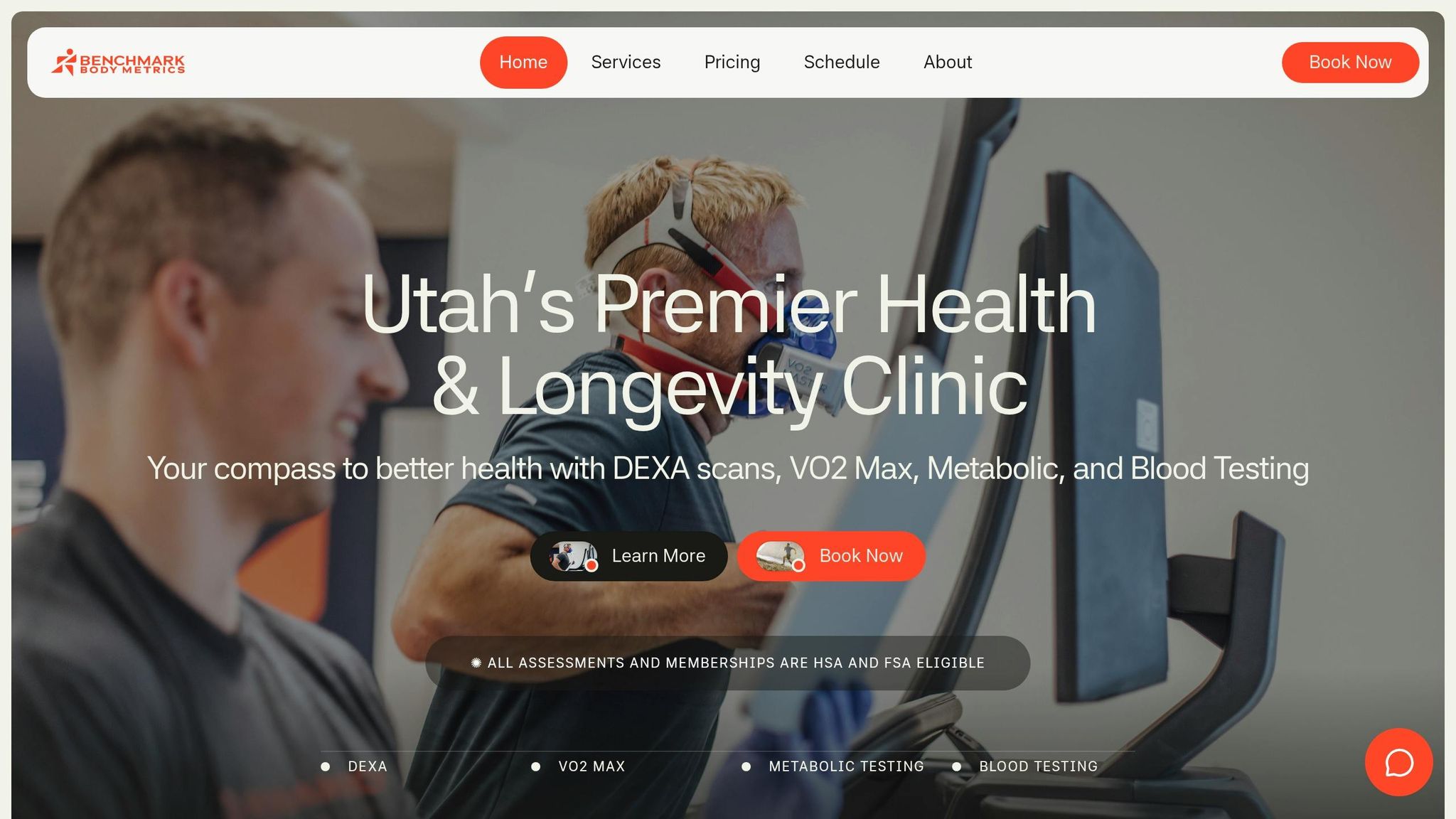
The VO₂ max test at Benchmark Body Metrics is a carefully structured process designed to measure your cardiovascular capacity. It kicks off with a pre-test screening, where staff review your fitness level, health history, and exercise habits to determine the best starting intensity for you.
Next, you’ll be outfitted with a heart rate monitor and a special mask that’s connected to a metabolic analyzer. This setup tracks your oxygen intake and carbon dioxide output, giving precise data on your performance. Before the test begins, the equipment is calibrated - a process that takes about 4–5 minutes - to ensure the readings are accurate.
Once calibration is done, you’ll start with a 10-minute warm-up at a low intensity, typically around 50–60% of your age-predicted maximum heart rate. This helps your body get ready for the main test. The actual test uses a graded exercise protocol, where the intensity ramps up in stages every minute. For example, cyclists might see an increase of 10–30 watts per stage, while runners may face changes in speed or incline. This phase usually lasts 8–12 minutes.
Since the mask prevents talking, you’ll use hand signals to share your Rate of Perceived Exertion (RPE) on a scale from 1 to 10. The test continues until you reach exhaustion, can’t maintain the pace, or your oxygen consumption levels off. Afterward, you’ll cool down for 5–10 minutes, and the staff will remove the mask. This detailed process ensures you get precise and actionable results.
Benchmark Body Metrics takes accuracy seriously, using top-tier methods and equipment to deliver reliable results. The tests are conducted under the supervision of trained technicians who oversee every step.
The lab environment is tightly controlled to eliminate variables like temperature, humidity, or altitude, which could skew the results. Unlike fitness trackers that approximate VO₂ max based on heart rate, the lab uses calibrated metabolic carts to directly measure oxygen and carbon dioxide levels, achieving a margin of error within ±3%.
"Clinical grade equipment and accuracy run by trained technicians."
- Benchmark Body Metrics
This level of precision matters. A 1-MET increase in VO₂ max (about 3.5 ml/kg/min) has been linked to a 13% drop in all-cause mortality risk, highlighting the importance of accurate measurements.
Understanding the process can help ease any worries you might have about the test. The VO₂ max test is non-invasive and tailored to your fitness level. You can stop at any time if you feel unwell, and trained staff closely monitor your heart rate, blood pressure, and oxygen levels throughout the test.
Some people worry about wearing the mask, but the key is to breathe naturally to ensure steady readings. It’s also normal to feel heavy breathing or muscle burn as your body approaches its lactate threshold.
Marathon runner Bryce Church shared his experience:
"The VO₂ test helped me tweak my training to get the most out of what my body has to work with. I got my best half marathon time by a few minutes!"
- Bryce Church, Marathon Runner
After the test, staff take the time to explain your results in detail, helping you make sense of the data and how it can improve your training.
Now that you've completed your VO₂ max test, it's time to make sense of the numbers.
Your VO₂ max score measures how much oxygen your body can use during intense exercise, expressed in mL/kg/min . In simpler terms, it reflects how efficiently your heart, lungs, and muscles work together. A higher score means you can perform at a higher intensity for a longer time .
This score essentially shows how well your body delivers oxygen to your muscles and how effectively they use it . Dr. Matthew Kampert from Cleveland Clinic explains:
"A high VO2 max across the lifespan is the single most powerful marker of physiological reserve".
Your results also highlight key ventilatory thresholds, which help pinpoint your ideal training zones based on heart rate, speed, or power output. For context, men aged 30–39 with scores between 47.0–51.5 mL/kg/min are in the "Good" category, while scores of 58.3 or higher are classified as "Superior" . For women in the same age group, "Good" scores range from 41.0–45.2 mL/kg/min, with "Superior" starting at 52.5 .
Your VO₂ max score isn't just a number - it's a tool to guide your training. For example, your VO₂ max pace (the intensity you can maintain for 6–8 minutes) is a great benchmark for high-intensity interval training (HIIT). To boost your score, try intervals like 3–4 minutes of hard effort followed by 2–3 minutes of recovery .
If you're new to structured training, you might see a 10–15% improvement, while seasoned athletes may gain 3–10% as they approach their genetic potential . While genetics play a role - accounting for 40–50% of your capacity - the rest comes down to consistent training. Even modest improvements, like moving from "Poor" to "Fair", can significantly lower mortality risk if your focus is on long-term health.
To train effectively and reduce injury risk, balance high-intensity efforts with Zone 2 training. These steady, moderate sessions build endurance without overtaxing your body . Plus, a higher VO₂ max improves running economy, letting you maintain marathon pace with less strain, saving energy for the long haul.
With a clear understanding of your VO₂ max, you can set realistic goals and track your progress over time.
Once you've set your goals, it's important to monitor your progress. Retest every 3–6 months to see how your body adapts and whether your training is paying off. Stick to the same testing method - whether it's a lab test at Benchmark Body Metrics or a field test like the Cooper 12-minute run - to ensure consistent comparisons .
While lab tests are the most accurate, wearables like Garmin, Apple, or Oura devices can track trends between tests . These gadgets estimate VO₂ max based on heart rate, pace, and variability, with some achieving up to 95% accuracy. Use them to follow long-term changes rather than worrying about daily fluctuations caused by factors like stress or weather .
Complementary metrics can also provide insights. For instance, tracking heart rate drift during steady-state runs can signal improved aerobic fitness - less drift means better efficiency. Similarly, better race times in events like a 5K or 10K can confirm your progress. Keep in mind, VO₂ max naturally declines by 5–10% per decade after age 30, so staying consistent with your training is crucial to maintaining or even improving your aerobic capacity .
Getting ready for your first VO₂ max test doesn’t have to be complicated. Stick to the basics: plan rest days, eat well-balanced meals, stay hydrated, and arrive rested. These simple steps help ensure the test captures your true oxygen uptake, providing accurate and reliable results.
Opting for a lab-based VO₂ max test, such as those offered at Benchmark Body Metrics (priced between $150–$250), gives you a top-tier measure of your cardiovascular fitness. It’s more than just a number - it’s a key indicator of your overall health. As Dr. Matthew Kampert from Cleveland Clinic explains:
"VO2 max really gives you an objective view of your overall health".
Better VO₂ max scores are tied to lower risks of heart disease, stroke, and even cognitive decline.
Once you’ve got your baseline results, use them to shape your training. If you’re just starting out, you can aim for a 10% to 15% improvement within a few months of consistent effort. In fact, measurable progress can often be seen in as little as 10 weeks.
To track your progress, consider retesting every 6 to 12 months. Stick to the same facility and testing protocol to ensure your results are comparable over time. Use this data to fine-tune your training and keep your cardiovascular health on the right track.


.svg)
