VO₂ max is a measure of how efficiently your body uses oxygen during intense exercise. It’s expressed in milliliters of oxygen per kilogram of body weight per minute (mL/kg/min) and is widely considered a key indicator of cardiovascular fitness. What counts as a "good" VO₂ max depends on factors like your age, sex, and fitness level. For example:
Your VO₂ max naturally peaks in your 20s and declines with age, but regular aerobic exercise can slow this decline. Improving your VO₂ max can lower your risk of mortality and boost your overall fitness. To improve it, focus on aerobic training, high-intensity intervals, and maintaining a healthy body composition. VO₂ max testing helps track progress and tailor workouts for better results.
Let’s break down what VO₂ max is and how it’s assessed.
VO₂ max refers to the maximum amount of oxygen your body can take in, transport, and use during one minute of intense physical activity. The term itself is straightforward: V stands for volume, O₂ is oxygen, and max represents the peak your body can achieve. Essentially, it’s a measure of your aerobic capacity - higher numbers indicate better fitness levels.
This value is typically expressed as milliliters of oxygen per kilogram of body weight per minute (mL/kg/min), which is known as relative VO₂ max. This format allows for fairer comparisons by factoring in body size. On the other hand, absolute VO₂ max, measured in liters per minute (L/min), shows total oxygen capacity without adjusting for weight.
"This relative measure enables tailored fitness comparisons by accounting for body size." - Kate Baird, Exercise Physiologist, Hospital for Special Surgery
Why does this distinction matter? Two individuals could have the same absolute VO₂ max, but the lighter person would score higher in relative terms. This is why body composition significantly affects your VO₂ max score.
With this understanding of what VO₂ max represents, let’s explore how it’s measured.
The most accurate way to measure VO₂ max is through a graded exercise test (GXT). This test is usually performed on a treadmill or stationary bike while wearing a respiratory mask connected to a gas analyzer. The analyzer measures the oxygen you inhale versus the oxygen left in your exhaled air. At the same time, a heart rate monitor tracks your cardiovascular response.
During the test, the intensity ramps up every two to three minutes - by increasing speed, incline, or resistance - until you either reach exhaustion or your oxygen uptake plateaus despite greater effort. This plateau indicates your VO₂ max.
A proper graded exercise test lasts about 10–20 minutes and requires specialized, clinical-grade equipment to ensure precise results. While smartwatches offer VO₂ max estimates for convenience, their accuracy can vary by 3 to 5 mL/kg/min. That margin of error could shift you into a completely different fitness category.
This detailed testing is invaluable for tracking fitness progress and planning training, especially since VO₂ max naturally declines with age. Accurate results provide a solid benchmark and help guide effective workout adjustments.
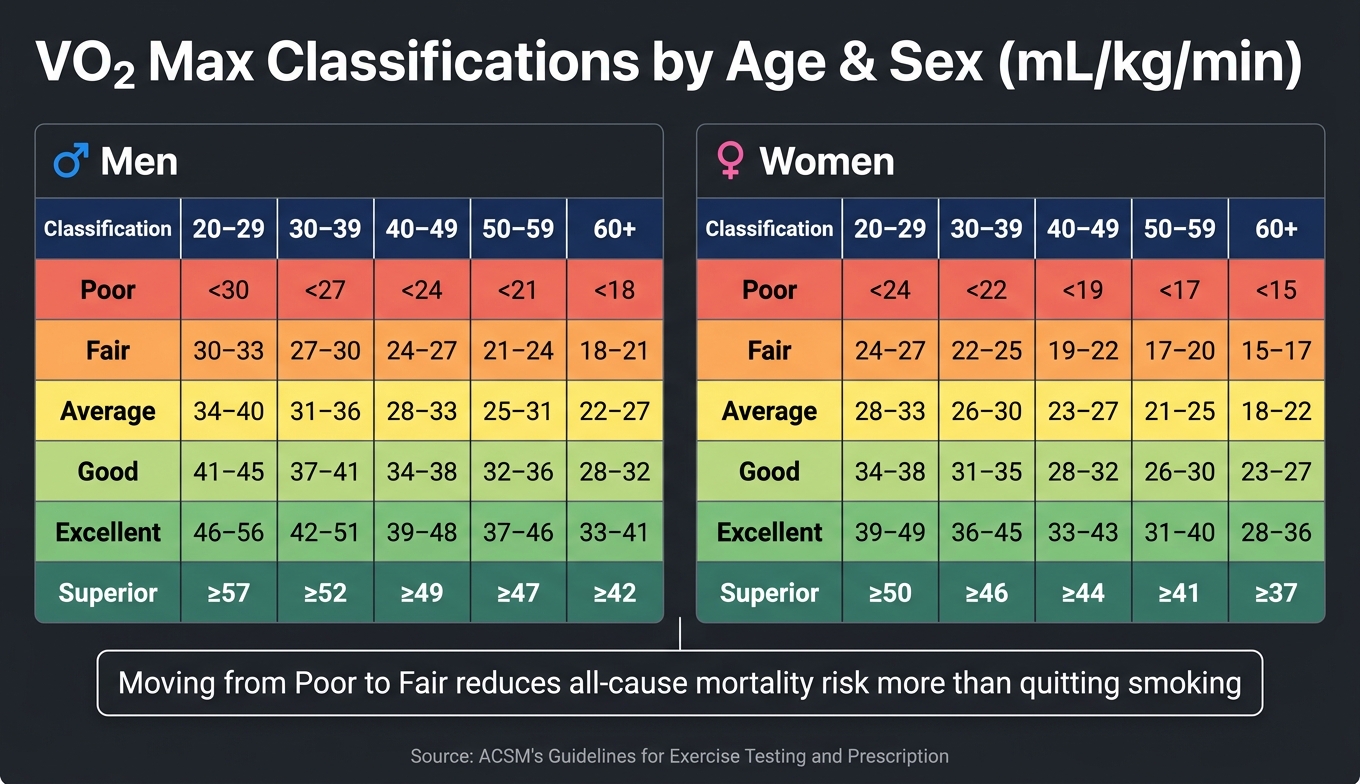
VO₂ Max Chart by Age and Sex: Good, Excellent & Superior Ranges
Understanding what qualifies as a "good" VO₂ max requires some context. It's not a one-size-fits-all number - it depends on factors like age, sex, and training history.
Three key factors play a big role in determining VO₂ max: age, sex, and training history.
Men generally score 10% to 15% higher than women in the same age group. This difference stems from physiological characteristics. Men tend to have more hemoglobin, larger heart volumes, and higher lean muscle mass, while women typically have a higher body fat percentage - all of which influence VO₂ max.
Genetics also matter. About 40% to 50% of your VO₂ max potential is determined by the genes you inherit. However, your training history is the variable you can control, and it has a significant impact on how much of your VO₂ max potential you can reach.
To figure out where you stand, find your age group and sex on the chart, then match your VO₂ max score (measured in mL/kg/min) to its category. The American College of Sports Medicine (ACSM) uses six classifications: Poor, Fair, Average, Good, Excellent, and Superior.
Here are the ranges:
Men - VO₂ Max Classification (mL/kg/min)
| Classification | 20–29 | 30–39 | 40–49 | 50–59 | 60+ |
|---|---|---|---|---|---|
| Poor | <30 | <27 | <24 | <21 | <18 |
| Fair | 30–33 | 27–30 | 24–27 | 21–24 | 18–21 |
| Average | 34–40 | 31–36 | 28–33 | 25–31 | 22–27 |
| Good | 41–45 | 37–41 | 34–38 | 32–36 | 28–32 |
| Excellent | 46–56 | 42–51 | 39–48 | 37–46 | 33–41 |
| Superior | ≥57 | ≥52 | ≥49 | ≥47 | ≥42 |
Women - VO₂ Max Classification (mL/kg/min)
| Classification | 20–29 | 30–39 | 40–49 | 50–59 | 60+ |
|---|---|---|---|---|---|
| Poor | <24 | <22 | <19 | <17 | <15 |
| Fair | 24–27 | 22–25 | 19–22 | 17–20 | 15–17 |
| Average | 28–33 | 26–30 | 23–27 | 21–25 | 18–22 |
| Good | 34–38 | 31–35 | 28–32 | 26–30 | 23–27 |
| Excellent | 39–49 | 36–45 | 33–43 | 31–40 | 28–36 |
| Superior | ≥50 | ≥46 | ≥44 | ≥41 | ≥37 |
Source: ACSM's Guidelines for Exercise Testing and Prescription
Here’s an interesting takeaway: moving from Poor to Fair reduces your risk of all-cause mortality more than quitting smoking. You don’t need to aim for "Superior" to see meaningful health improvements - just moving up one tier can make a big difference.
VO₂ max naturally peaks in your 20s and early 30s, then starts to decline. For those who are sedentary, it drops by about 10% per decade. This is due to physiological changes like a lower maximum heart rate, reduced heart stroke volume, muscle loss, and weight gain - all of which affect your score.
The good news? Regular aerobic training can slow this decline, cutting it nearly in half to about 0.5% per year. Masters athletes - those who stay active as they age - lose VO₂ max at a much slower rate compared to their sedentary counterparts. After age 70, the decline does speed up, but an active lifestyle still helps maintain cardiorespiratory fitness.
"A high VO₂ max across the lifespan is the single most powerful marker of physiological reserve. Develop it early and maintain it consistently and you will measurably increase your years lived in good health." - Dr. Matthew Kampert, DO, Sports Medicine Physician, Cleveland Clinic
The takeaway here: instead of comparing your VO₂ max to someone much younger, focus on your own age group. Track your progress over time, and aim to improve within your tier. This perspective helps you set realistic goals while keeping your fitness journey sustainable.
VO₂ max measures your aerobic capacity, but performance is about more than just capacity - it's about how well you use it. Your thresholds and efficiency play a huge role in determining your potential. Two athletes with the same VO₂ max can have vastly different results depending on how efficiently they operate and the intensity at which their body starts to struggle.
Here’s a way to think about it: your lactate threshold is like the point where your engine starts to overheat, and your running economy is your fuel efficiency - how far you can go on a gallon of gas. These factors are just as important as VO₂ max when it comes to performance.
Running economy alone can differ by 20% to 30% between athletes with identical VO₂ max levels. A runner with better efficiency uses less oxygen at the same pace, allowing them to stay below their anaerobic threshold longer and delay fatigue. Take Eliud Kipchoge, for example. His VO₂ max, estimated at 83–85 mL/kg/min, is lower than the all-time record of 97.5 mL/kg/min. Yet, in September 2018, he set the Berlin Marathon world record with a time of 2:01:39. How? His exceptional running economy - 155–160 mL O₂/kg/km - allowed him to maintain 92% of his VO₂ max throughout the race.
"Kipchoge didn't have the biggest engine - he was the athlete who ran his engine most efficiently and sustained it at the highest revolutions." - Hüseyin Akbulut, MSc, Sport Scientist
For sedentary individuals, the lactate threshold kicks in at just 50–60% of their VO₂ max, while elite athletes can push it to 85–90%. This demonstrates that efficiency, not just raw capacity, defines performance. And since VO₂ max naturally declines with age, improving thresholds becomes even more critical over time.
Efficiency goes hand in hand with understanding your aerobic and anaerobic thresholds. Your aerobic threshold (also called LT1 or VT1) is the point where your body starts relying more on carbohydrates than fat for energy - this is where exercise feels comfortable and sustainable. On the other hand, your anaerobic threshold (LT2 or VT2) marks the intensity where lactate builds up faster than your body can clear it, leading to rapid fatigue.
A study of 1,411 endurance-trained runners found that VT1 occurs at an average of 85.1 ± 4.6% of peak heart rate, while VT2 happens at 93.5 ± 2.5% of peak heart rate. Although these thresholds are relatively close in percentage, the way they affect training is very different. For instance, pushing past VT1 on what’s supposed to be an easy recovery day can lead to unnecessary fatigue and slow your progress.
"Understanding where your thresholds are helps you ensure that easy days stay easy, medium days stay medium, and hard days are truly hard." - Alex Hutchinson, Outside Online
This is why VO₂ max tests are so helpful - they pinpoint your exact heart rate zones and thresholds, allowing you to create a training plan tailored to your body. This targeted approach can lead to faster and more effective improvements.
VO₂ max is measured relative to body weight, and here's the thing - fat tissue doesn’t use oxygen during exercise. That means carrying extra fat lowers your relative VO₂ max, while muscle, which actively uses oxygen, helps improve it.
"If you lose weight and nothing changes with your fitness, [your relative VO₂ max] is going to go up. That's just how the maths works." - Kate Baird, Exercise Physiologist, Hospital for Special Surgery
Reducing excess body fat is one of the most impactful first steps you can take to improve VO₂ max, even before diving into intense training. Tools like a DEXA scan from Benchmark Body Metrics give you a detailed breakdown of fat mass, lean muscle, and visceral fat, so you can see exactly where you stand and track real progress. Pair this with metabolic testing to understand how many calories your body burns at rest, and you’ll have a clear path to building a nutrition plan that works for you. Once you’ve laid this foundation, you can focus on training strategies to further enhance your VO₂ max.
Your current fitness level plays a big role in determining the best way to improve your VO₂ max. If you’re just starting out, the good news is that you can make significant progress with simple cardiovascular exercise. For example, beginners can achieve VO₂ max gains of 20% to 30% in just three to six months by doing 30 minutes of brisk walking three to four days a week.
"Doing cardiovascular exercise three to four days a week may improve their VO₂ max by 20%–30% over three to six months." - Andrew Jagim, Ph.D., Sports Medicine, Mayo Clinic
For those who are already active, high-intensity interval training (HIIT) can speed up improvement. A 2013 meta-analysis found that HIIT boosted VO₂ max by 4.2 mL/kg/min in just 6–12 weeks. The most effective HIIT routine for experienced athletes involves 3- to 5-minute intervals at your 3k–5k race pace, repeated 4 to 6 times, three times per week over eight weeks. Adding two 30-minute strength training sessions per week can also help, as stronger muscles use less oxygen to maintain the same pace, making you more efficient overall.
Here’s a quick breakdown of training methods:
| Training Method | Effort Level | Frequency | Ideal For |
|---|---|---|---|
| Aerobic Base (walking/jogging) | Moderate | 3–4× per week | Beginners / Sedentary |
| Classic Intervals (3–6 min) | 3k–5k pace | 1–2× per week | Experienced Athletes |
| Hill Repeats (60–90 sec) | Hard effort | Weekly | All levels |
| Threshold Runs | "Comfortably hard" | 1–2× per week | Intermediate/Advanced |
| Strength Training | Moderate | 2× per week | All levels |
Tracking your progress with objective test data is a game-changer for improving VO₂ max. Regular testing helps you monitor how your training impacts your performance and can even counteract the natural decline in VO₂ max that comes with age. VO₂ max testing not only measures your progress but also identifies your heart rate zones and thresholds, allowing you to fine-tune your workouts. Combine this with DEXA scans to monitor changes in body composition, and you’ll have a complete picture of what’s driving your results. If your progress plateaus, this data makes it easier to adjust your approach.
As Andrew Jagim, Ph.D., explains:
"This objective feedback is one way to help you measure progress and shape your training regime. For example, you may map out your training sessions based on what percentage of your VO₂ max you want to work at that day."
While genetics and natural physiology establish your starting point, improving body composition and maintaining consistent training can make a big difference in boosting your VO₂ max.
But here's the thing: fitness isn't just about the number. It’s about how well your body uses oxygen during exercise. A higher VO₂ max doesn’t automatically mean better performance. Two people with the same VO₂ max score can perform at completely different levels. Why? Factors like lactate threshold - how much of your "aerobic ceiling" you can sustain - and movement economy, which measures how efficiently you use oxygen at a specific pace, play a huge role. VO₂ max tests also help identify your heart rate zones and thresholds, giving you a roadmap for smarter training. If you’re only focused on increasing VO₂ max without understanding these thresholds, you could be missing out on major performance gains.
For most people, improving body composition - specifically by reducing excess fat - is the quickest way to boost relative VO₂ max. After that, the type of training matters. Beginners benefit from steady aerobic exercises, while advanced athletes can see gains through structured interval training.
"A high VO₂ max across the lifespan is the single most powerful marker of physiological reserve. Develop it early and maintain it consistently and you will measurably increase your years lived in good health." - Dr. Matthew Kampert, Sports Medicine Physician, Cleveland Clinic
Benchmark Body Metrics combines VO₂ max testing with in-depth body composition and metabolic analysis, helping you set clear, data-driven training goals without the guesswork.
Smartwatch VO2 max estimates aren't always spot-on. Research indicates they can have a margin of error ranging from 5% to 15% when compared to lab-based measurements. While these estimates are helpful for monitoring general fitness trends, they might not be reliable enough for clinical purposes or high-level athletic training.
To get better results, make sure your user profile is always up to date, log outdoor runs consistently, and, if possible, pair your smartwatch with a chest-strap heart rate monitor for improved accuracy.
Frequent lab tests aren't typically needed for most people. Exceptions include elite athletes, those who have hit a performance plateau for a year, or individuals requiring specific cardiac evaluations. For tracking fitness trends, wearable devices are a practical alternative. If you decide to undergo formal testing to fine-tune metrics like heart rate or power zones, make sure the testing protocol remains consistent. This ensures the results can be accurately compared over time.
Yes, relative VO2 max is determined by dividing the amount of oxygen your body consumes by your total body weight. When you lose body fat, this score improves - even if your aerobic capacity remains unchanged - because fat tissue doesn’t require oxygen during exercise. While this doesn’t automatically mean your cardiovascular fitness has improved, it does indicate better relative efficiency due to carrying less weight.


.svg)
