I’d use higher-quality food to make eating fewer calories easier - not as a guarantee of weight loss. My starting point: swap juice for whole fruit, or replace part of a calorie-dense side with beans, vegetables, or lean protein.
Here’s what I’d focus on:
The goal isn’t just better food. It’s <u>better food that helps you eat fewer calories than your body burns</u>.
That advantage comes from how protein, fiber, water, and energy density affect fullness. Foods rich in protein, fiber, or water can make meals more filling without adding more calories.
During weight loss, protein helps you feel full and preserve lean mass, including muscle.
Fiber adds bulk, while water-rich foods add volume without many calories. Energy density means calories per gram. Foods with lower energy density give you a larger portion for the same calories.
| Food | Fiber | Water content | Energy density | Fullness per calorie |
|---|---|---|---|---|
| Nonstarchy vegetables | High | High | Low | Generally higher |
| Cooked beans | High | High | Low to moderate | Generally higher |
| Broth-based meals | Varies | High | Usually low | Often higher |
| Calorie-dense snacks | Usually lower | Usually lower | High | Generally lower |
Added oils, creamy sauces, and rich toppings can quickly increase calories. Meals built around vegetables, beans, and protein tend to keep you fuller per calorie.
Whole fruit follows the same pattern: it usually fills you up more than juice.
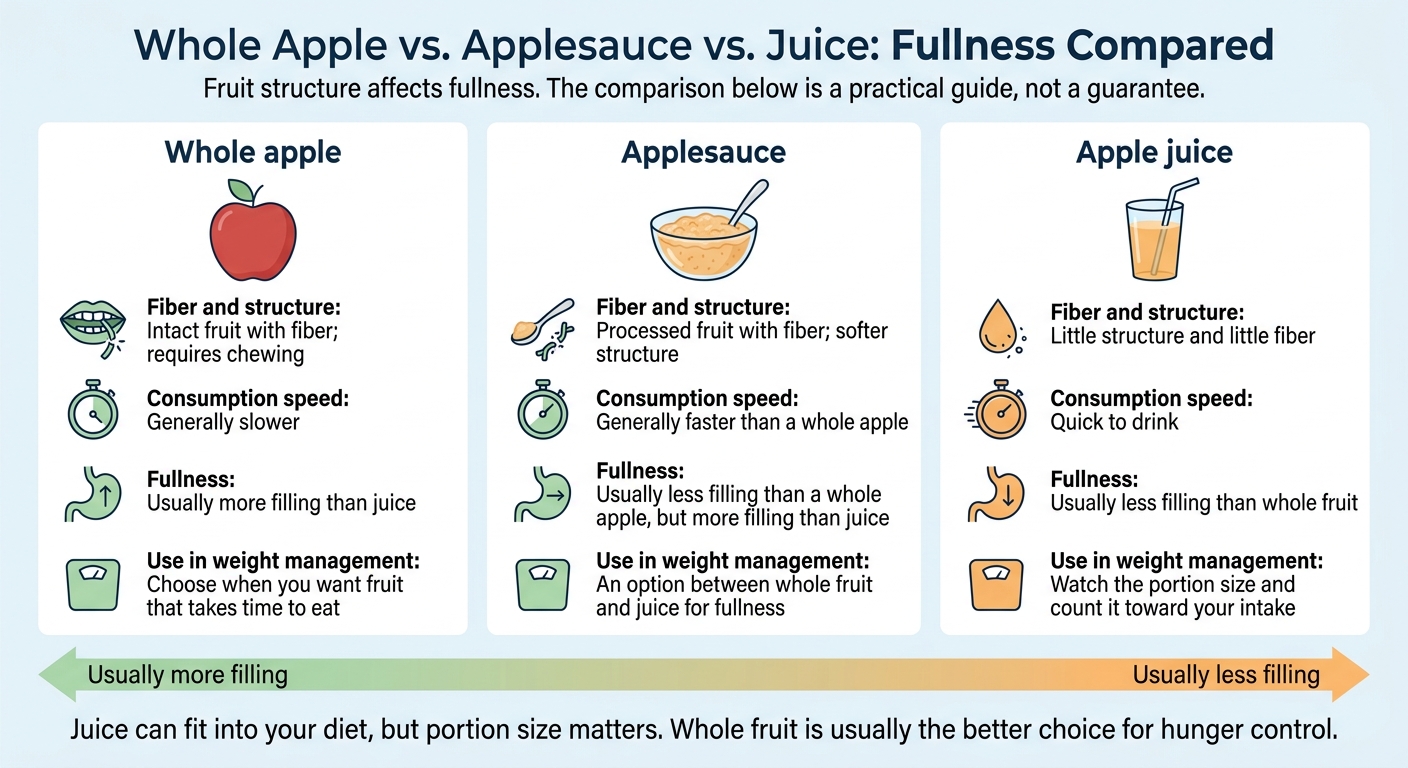
Whole Apple vs. Applesauce vs. Juice: Fullness Compared
Whole fruit takes longer to eat than juice takes to drink, so it usually leaves you feeling fuller.
Fruit structure affects fullness. The comparison below is a practical guide, not a guarantee.
| Food or drink | Fiber and structure | Consumption speed | Fullness | Use in weight management |
|---|---|---|---|---|
| Whole apple | Intact fruit with fiber; requires chewing | Generally slower | Usually more filling than juice | Choose when you want fruit that takes time to eat |
| Applesauce | Processed fruit with fiber; softer structure | Generally faster than a whole apple | Usually less filling than a whole apple, but more filling than juice | An option between whole fruit and juice for fullness |
| Apple juice | Little structure and little fiber | Quick to drink | Usually less filling than whole fruit | Watch the portion size and count it toward your intake |
Juice can fit into your diet, but portion size matters. Whole fruit is usually the better choice for hunger control.
Beans and vegetables follow the same pattern: they usually provide more fullness per calorie than snack foods.
The same fullness principle applies to savory meals. Beans provide protein and fiber, while nonstarchy vegetables add water and volume. Like whole fruit, they offer more food for fewer calories, helping you stay full while keeping portions in check.
How you prepare the meal matters, too. Using less oil in dressings and cooking can change its calorie count quickly. Beans and vegetables still add volume, but added oils can offset some of that advantage.
On busy days, build your meal around beans and vegetables rather than treating them as extras. This simple swap can replace calorie-dense snacks and help you stay full.
Replace foods rather than adding more to your plate.
Choose whole fruit instead of juice, or replace part of a calorie-dense side dish with beans, vegetables, or lean protein.
Watch portions, too. Nuts, oils, and avocados are calorie-dense, and whole grains still need portion control.
After making swaps, check whether your meals keep you full longer and help you maintain a calorie deficit. Track fullness after meals, energy, strength, and your weight trend. Comparing body composition methods can provide more detail, but daily hunger and weight trends are the most practical guide.
Meals that keep hunger down are easier to stick with.
Higher-quality foods can make a calorie deficit easier to maintain, but portions still determine the outcome.
To lose weight while keeping muscle, aim for 0.8 to 1.2 grams of protein per pound of body weight each day. Spread that intake evenly across 3 to 5 meals, ideally getting 30 to 45 grams of high-quality protein at each meal.
If you take weight loss medications, your target may need to change to 1.2 to 1.6 grams per kilogram of body weight daily - about 0.54 to 0.73 grams per pound - to help limit excessive muscle loss.
Yes. Frozen and canned foods can be convenient and just as nutritious as fresh foods. Choose plain frozen vegetables, fruit without added sugar, and beans or lean proteins packed in water.
As part of a balanced diet, these nutrient-dense foods can help you feel full longer and manage portions. That can make a calorie deficit easier to maintain. Weight loss still depends on consuming fewer calories than you burn overall.
Choose nutrient-dense foods with protein, fiber, and fewer calories per serving to feel satisfied on fewer calories. Include protein at every meal to help you stay satisfied and maintain muscle. Pick fiber-rich vegetables, beans, and whole grains instead of calorie-dense snacks to help manage hunger.
These choices can make a calorie deficit easier to stick with without strict tracking, though how much you eat still affects weight loss.