Losing fat while gaining muscle - known as body recomposition - is possible with the right approach. Here's how it works:
This approach works best for beginners, those returning to training, or individuals with higher body fat. Advanced lifters or very lean individuals may need separate bulking and cutting phases. Consistency and patience are essential, as visible changes often take 3–6 months. Tracking tools like body composition testing methods and strength logs can help refine your plan over time.
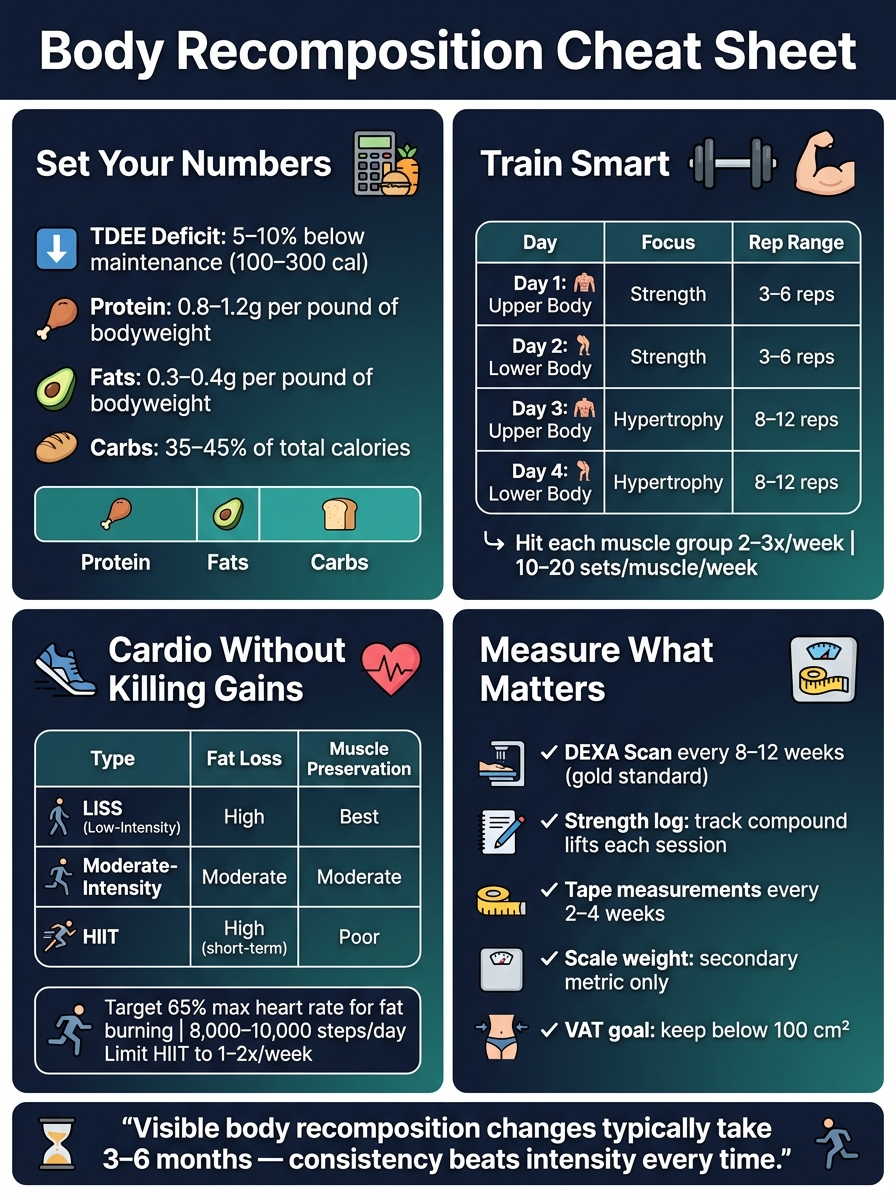
Body Recomposition Cheat Sheet: Nutrition, Training & Cardio
The starting point for any recomposition plan is figuring out your Total Daily Energy Expenditure (TDEE) - basically, the number of calories your body burns daily. You can estimate this by multiplying your weight (in pounds) by an activity multiplier based on how often you train:
| Training Frequency | Multiplier |
|---|---|
| 3 workouts/week | 14.5–15.5 |
| 4 workouts/week | 15.5–16.5 |
| 5 workouts/week | 16.0–17.0 |
| 6+ workouts/week | 17.0–18.0 |
Once you calculate your TDEE, stick to that calorie intake for 2–4 weeks. If your weight stays within ±1 pound, you’ve found your maintenance level. From there, aim for a 5–10% calorie deficit (about 100–300 calories below maintenance) to lose fat while still allowing your body to recover and build muscle.
If you’re a beginner or carry more body fat, you may handle a larger deficit - up to 20%. On the other hand, leaner or more experienced lifters should stay closer to maintenance or try calorie cycling. For example, eat at maintenance on training days and slightly below it on rest days.
Once your calorie goals are set, the next step is nailing your macronutrient ratios.
With calories locked in, focus on protein, fats, and carbohydrates to fuel your goals. Here’s a breakdown:
| Macronutrient | Target Range | Role |
|---|---|---|
| Protein | 0.8–1.2 g per pound | Muscle repair and satiety |
| Fats | 0.3–0.4 g per pound | Hormonal health |
| Carbohydrates | 35–45% of total calories | Energy for training and recovery |
Protein should be your top priority. Aim for 0.8–1.2 grams per pound of body weight to support muscle repair and keep you feeling full. Protein also has a high thermic effect, meaning 25–30% of its calories are burned during digestion.
Fats are equally important, but you only need a minimum of 0.3 grams per pound to maintain hormonal balance. The rest of your calories should come from carbohydrates, which should make up about 35–45% of your total intake. Carbs are crucial for fueling workouts and replenishing muscle glycogen.
The impact of protein is hard to overstate. A 2016 study published in the American Journal of Clinical Nutrition showed just how effective it can be. Researchers led by Dr. Stuart Phillips put 40 overweight men on a steep 40% calorie deficit for four weeks. The group eating 2.4 g/kg of protein (around 1.1 g per pound) gained 1.2 kg of lean mass while losing 4.8 kg of fat. Meanwhile, the lower-protein group (1.2 g/kg) only managed to maintain their muscle mass.
"The outcome is a dial you turn with protein dose and training intensity - not a switch that is either on or off." - Stuart Phillips, Professor, McMaster University
To maximize muscle protein synthesis (MPS), spread your protein intake evenly throughout the day. Your body can only use a certain amount of protein at a time for muscle building. Each meal should include enough protein to reach a leucine threshold of about 2.5–3 grams, which generally means 30–45 grams of high-quality protein per meal.
Here’s a simple approach to protein distribution:
For adults over 40, the protein requirement per meal may be slightly higher - closer to 40 g - to achieve the same anabolic response that younger adults can get with about 25 g.
With your nutrition plan in place, the next step is to align it with a training program designed to maximize results.
Once your nutrition plan is dialed in, the next step is shaping your weekly workout routine. Training 3–5 days a week strikes the right balance - it gives your muscles enough work to grow while allowing time for recovery. Since muscle protein synthesis lasts around 24–48 hours after a workout, aiming to hit each muscle group at least twice a week is far more effective than a once-a-week approach.
The key is consistency. Choose a workout split that matches your schedule and experience level. If you're newer to lifting or have limited time, a 3-day full-body split is a great starting point. For those with more experience, a 4-day upper/lower split offers a nice mix of strength and volume. Here's an example of a 4-day plan:
| Day | Focus | Key Exercises |
|---|---|---|
| Day 1: Upper Body | Strength | Bench Press, Rows, Overhead Press |
| Day 2: Lower Body | Strength | Squats, Romanian Deadlifts, Calf Raises |
| Day 3: Upper Body | Hypertrophy | Incline DB Press, Pull-ups, Lateral Raises |
| Day 4: Lower Body | Hypertrophy | Leg Press, Leg Curls, Bulgarian Split Squats |
Strength days focus on heavier weights with 3–6 reps per set and longer rests (3–5 minutes) to maximize power. On hypertrophy days, aim for 8–12 reps with shorter rest periods (90–120 seconds) to build muscle volume and increase metabolic stress.
With this structure in place, tracking your progress becomes essential for fine-tuning your approach.
Every session should start with compound lifts like squats, deadlifts, bench presses, rows, and pull-ups. These exercises engage multiple joints and muscle groups, creating the mechanical tension needed to stimulate muscle growth. Performing compound lifts at the beginning of your workout ensures you're using your peak energy and focus. If you push these to later in the session, fatigue from accessory exercises can reduce their effectiveness.
Research backs this up: in a study involving untrained individuals, combining resistance training with a high-protein diet and a calorie deficit led to an average gain of 2.6 lbs of muscle while losing 10.5 lbs of fat in just four weeks. Compound lifts were the foundation of these programs.
"Body recomposition is a byproduct of capacity. When clients build strength, recover well, and fuel consistently, their body changes without chasing extremes. The goal isn't smaller. It's stronger, steadier, and with more capacity for life." - Jodi Barrett, CEO of KBStronger Training
Building strength requires progressive overload - a principle you can't skip. If you're not gradually getting stronger, your muscles won't have a reason to grow. A simple way to implement this is through the double progression model: aim for the top of your rep range (e.g., 12 reps in an 8–12 range), and once you hit it for all sets, increase the weight by 2.5–5 lbs and start back at 8 reps. Keeping a log of your weights, reps, and sets helps ensure you're progressing over time.
If your strength plateaus or declines for more than two months, it could mean you're not recovering enough, eating enough protein, or managing your training volume properly.
For optimal growth, aim for 10–20 challenging sets per muscle group each week, with most people finding 12–18 sets to be the sweet spot. On rest days, light activities like walking can aid fat loss without hindering recovery.
Cardio doesn’t have to sabotage your muscle-building efforts - if you approach it the right way. Research suggests that the interference effect, where cardio hampers muscle growth, only becomes a concern when intense cardio exceeds 4 hours per week. When used wisely, cardio can be a powerful tool for burning fat, particularly the stubborn visceral fat that accumulates around your organs.
Not all cardio methods affect muscle and fat the same way. A large meta-analysis of 62 randomized controlled trials involving 4,429 participants revealed that low-intensity aerobic exercise is the most effective for reducing fat mass while also preserving lean muscle. On the other hand, high-intensity aerobic exercise ranked much lower for maintaining muscle.
| Cardio Type | Fat Loss Effectiveness | Muscle Preservation |
|---|---|---|
| Low-Intensity (LISS) | High | Best |
| Moderate-Intensity | Moderate | Moderate |
| High-Intensity (HIIT) | High (short-term) | Poor |
If your goal is to stay lean while keeping your muscle gains intact, aim for 8,000–10,000 steps per day. This helps burn calories effectively without overloading your body. For more structured cardio, limit high-intensity interval training (HIIT) to 1–2 sessions per week, each lasting less than 30 minutes. Think of HIIT as a bonus rather than the main focus of your routine.
Tracking your heart rate can also help you stay in the right zone for fat burning while avoiding unnecessary muscle fatigue.
Cardio intensity isn't just about how hard it feels - your heart rate tells the real story. At approximately 65% of your maximum heart rate, your body shifts to burning fat as its primary fuel source, making this the ideal range for fat loss and recomposition. Pushing harder, such as during intense cardio, relies more on glycogen, which can increase recovery demands and stress your system.
If you want precision, a VO2 Max test can map out your exact heart rate zones. Companies like Benchmark Body Metrics offer clinical-grade VO2 Max testing to determine your aerobic thresholds. This data helps you understand how your fitness level compares to age-based benchmarks. This ensures your cardio sessions are optimized for fat burning without interfering with your strength training.
When it comes to combining cardio with strength training, timing is everything. That’s because building muscle and burning fat rely on opposing cellular processes:
"mTOR builds muscle when glycogen is full and amino acids are saturated. AMPK burns fat when glycogen is depleted and energy is low. They cannot both run at maximum simultaneously."
To get the best of both worlds, separate cardio and strength training sessions whenever possible. For instance, perform intense cardio on your rest days or allow several hours between lifting and cardio. If you have to do both in the same session, always prioritize strength training first. This ensures your muscles get the energy and mechanical tension they need before fatigue kicks in.
Finally, if you’re doing significant amounts of cardio, adjust your protein intake to 1.6–2.0 g/kg of body weight to help counteract muscle breakdown.
Making adjustments to your fitness plan without reliable metrics is like driving without a map - it’s hard to know if you’re heading in the right direction. That’s where objective metrics step in, offering a clear view of your progress and helping you fine-tune your approach.
When it comes to body recomposition, tracking weight alone doesn’t tell the full story. Tools like DEXA (Dual-Energy X-ray Absorptiometry) provide a much more detailed picture. Since muscle is denser than fat, your weight might stay the same - or even increase - while your body becomes leaner and your clothes fit better.
A DEXA scan is considered the gold standard for measuring body composition. Unlike a basic scale, it provides a detailed breakdown of fat mass, lean muscle, and bone density, broken down by specific regions of your body. It also measures visceral adipose tissue (VAT), the fat surrounding your organs. Keeping VAT below 100 cm² is ideal, as higher levels (above 160 cm²) can increase the risk of type 2 diabetes and heart disease.
"A DEXA scan is the only way to know if your program is actually working. The scale might go down, but are you losing fat or muscle?" - Preamble Health
For tracking recomposition effectively, schedule DEXA scans every 8 to 12 weeks. This timeframe allows you to spot meaningful changes in muscle and fat distribution. Costs range from $75 to $300 depending on the provider and whether professional interpretation is included. For example, Benchmark Body Metrics offers clinical-grade DEXA scans with instant results and expert consultations, and the service is eligible for HSA/FSA reimbursement. While DEXA scans are more accurate than at-home BIA scales, the latter are more convenient but often produce inconsistent results due to factors like hydration and food intake.
Beyond body composition, understanding your metabolism and cardiovascular fitness can sharpen your approach. Two key tests to consider are Resting Metabolic Rate (RMR) testing and VO2 Max assessments.
By combining RMR and VO2 Max results, you can remove much of the trial-and-error from your nutrition and cardio strategies. Together, these tests provide a more complete view of your progress and help you make informed decisions.
While lab tests offer invaluable insights, they only tell part of the story. Pairing clinical data with everyday observations - like strength gains, energy levels, and sleep quality - provides a well-rounded view of your progress.
Strength gains, especially in compound lifts like squats, deadlifts, bench presses, and rows, are a strong indicator of muscle growth and retention, even if the scale doesn’t budge. As Ryan Valentine, a Body Recomp Specialist, explains:
"Strength is a leading indicator of body recomposition progress. Tape and photos are lagging indicators. By the time your waist is visibly smaller, your deadlift was already going up." - Ryan Valentine, Body Recomp Specialist
To track your progress, log your compound lifts during every session. Additionally, take tape measurements of your waist, hips, thighs, and arms every 2 to 4 weeks in the morning for consistency. These measurements, combined with clinical data, help you fine-tune your nutrition and training plans for optimal results.
Achieving body recomposition requires aligning your nutrition, strength training, and recovery with measurable data. This process isn’t about quick fixes - it’s about steady progress built on consistency rather than short bursts of intensity. By focusing on the core principles of nutrition, recovery, and compound strength training, and sticking to them week after week, you set yourself up for real results. Success here isn’t just physical; it’s also about maintaining the mental discipline to stay the course.
One of the toughest challenges isn’t what happens in the gym or the kitchen - it’s managing expectations. The scale might not show dramatic changes because muscle gain can offset fat loss. As Maura Donovan, MS, RD, wisely explains:
"results take time - changes won't occur overnight, but consistent effort yields progress"
Most meaningful changes to body composition take about three to six months. That timeline might test your patience, but every week of effort adds up, even if the progress feels invisible at first. Tracking both clinical and everyday metrics is essential to staying on track. Tools like DEXA scans, which measure body composition with precision, help you see beyond the scale. Other metrics, like strength improvements and shrinking waistlines, provide additional proof of progress.
For those looking to keep their approach data-driven, Benchmark Body Metrics offers services like DEXA scans, metabolic (RMR) testing, and VO2 Max assessments. These tests provide instant results and are even eligible for HSA/FSA plans. Scheduling a scan every 8–12 weeks allows you to make informed adjustments and avoid plateaus before they derail your progress. Stay consistent, trust the process, and let the data guide your decisions as you move forward.
Stable weight can sometimes mean you're swapping fat for lean muscle, as muscle takes up less space than fat. You might notice a leaner look or increased muscle definition as a result.
To track this, take progress photos monthly, measure your waist and hips, and keep a record of strength improvements during workouts. For more accurate insights, you could opt for a DEXA scan every 3–6 months to monitor changes in fat and muscle.
If your strength plateaus while you're maintaining your weight, it might be time to take a closer look at your recovery habits. Poor sleep or elevated stress levels can seriously impact your progress. To combat this, consider incorporating regular deload weeks into your routine. These weeks help manage fatigue and allow you to focus on holding onto your strength rather than constantly pushing for new personal records.
On the nutrition side, make sure you're consistently hitting your protein targets - aim for 2.2 to 2.6 grams per kilogram of body weight. Also, track your weight over a period of at least four weeks to ensure you're actually at maintenance and not unknowingly in a deficit or surplus.
To get the most out of combining cardio and lifting, focus on resistance training first to help maintain muscle mass. Always prioritize your lifting sessions before cardio - this ensures you have enough energy to tackle those heavy lifts effectively.
If your schedule allows, try to space out your cardio and lifting by at least three hours or even alternate them on different days. For cardio, go for low-impact options like cycling to minimize fatigue and avoid unnecessary muscle strain.
Keep an eye on your recovery and strength levels regularly. This will help you make sure that your cardio routine isn’t interfering with your progress in the gym.


.svg)
