Running slower might sound counterintuitive, but Zone 2 training - a low-intensity approach where your heart rate stays at 60–70% of its maximum - can significantly improve your endurance and speed. Elite athletes dedicate about 80% of their training to this effort level, and here's why it works:
To get started, calculate your Zone 2 heart rate (e.g., 60–70% of your max heart rate), use the talk test (you should be able to speak in full sentences), or try a lactate threshold test for precision. Aim for 3–5 sessions per week, adjusting duration based on your goals. Stick with it consistently, and you'll notice better performance over time.
Zone 2 training involves running at a steady, low-effort pace where your body primarily uses fat and oxygen for energy. It's just below your first lactate threshold (LT1), meaning your blood lactate levels remain stable - typically between 1.5 and 2.0 mmol/L.
This type of run feels almost effortless. You should be able to carry on a full conversation without needing to catch your breath. On a scale of 1 to 10, it’s around a level 3 or 4 - so easy, in fact, that it might seem too slow to be effective.
Zone 2 training drives some impressive cellular changes in your body. One key benefit is mitochondrial biogenesis - a process that increases the number and size of mitochondria in your muscle cells by 40–100% within 6–12 weeks. Since mitochondria produce energy, having more of them boosts your ability to sustain effort.
Zone 2 also promotes capillarization, which is the growth of tiny blood vessels around your muscles. This improves oxygen delivery and speeds up the removal of metabolic waste like lactate. Additionally, your heart adapts by strengthening and enlarging its left ventricle, enabling it to pump more blood with each beat. Over time, this reduces your working heart rate at the same pace.
Think of your body's fuel reserves: it stores roughly 2,000 calories of glycogen but has 30,000–50,000 calories of fat available. Zone 2 training teaches your body to tap into that fat supply more effectively, saving glycogen for when you really need it - like during a sprint, a steep climb, or a strong race finish. At Zone 2 intensity, about 60–70% of your energy comes from fat oxidation. This makes your running more efficient and helps you sustain faster paces for longer.
Zone 2 also plays a crucial role in recovery. Unlike high-intensity efforts that stress your central nervous system and need 24–48 hours to recover from, Zone 2 runs are gentle on your body. This low recovery demand is what allows elite runners to log high weekly mileage without breaking down. It’s also why the 80/20 rule - where 80% of training is easy and 20% is hard - works so well in endurance sports.
"Skip Zone 2, and you are building a house without a foundation." - TrainingZones.io
The table below highlights the key physiological changes that Zone 2 training fosters and how they benefit your running:
| Adaptation | What Happens | Benefit to You |
|---|---|---|
| Mitochondrial Biogenesis | Increase in the number and size of mitochondria in muscles | Greater energy production; less fatigue during long runs |
| Capillarization | Growth of new blood vessels around muscle fibers | Improved oxygen delivery and faster lactate clearance |
| Fat Oxidation | Better transport of fatty acids into mitochondria | Spares glycogen for intense efforts; reduces risk of "bonking" |
| Stroke Volume | Strengthening and enlargement of the heart's left ventricle | Pumps more blood per beat; lowers heart rate at the same pace |
| Lactate Clearance | Enhanced ability of slow-twitch fibers to clear lactate | Delays the onset of fatigue at higher intensities |
These adaptations are the foundation for improved running performance and endurance. Up next, we’ll explore how to determine your Zone 2 heart rate.
Figuring out your Zone 2 heart rate is key to ensuring your workouts are effective rather than just random exercise. It’s the difference between running with purpose and simply jogging. Here are three practical ways to pinpoint your Zone 2 intensity, each with varying levels of accuracy and effort.
One common method is calculating 60–70% of your maximum heart rate (MHR). The formula is straightforward: "220 minus your age." For example, a 40-year-old would have an estimated MHR of 180 bpm, making their Zone 2 range about 108–126 bpm. However, this is just a ballpark figure and can be off by as much as 10–30 bpm. As exercise physiologist Greg McMillan explains:
"The most commonly used formula - 220-minus-your-age - can be off by 10 to 30 beats per minute for any given individual."
If you’re looking for more accuracy, try formulas like the Tanaka formula (208 − 0.7 × age) or the Gulati formula (206 − 0.88 × age), which consider individual differences more effectively. Keep in mind that factors like heat, caffeine, or even stress can bump up your heart rate by 5–10 bpm without a real increase in effort.
For a simpler, gear-free option, the Talk Test is another great tool.
Don’t have a heart rate monitor? The talk test is a reliable and straightforward way to gauge Zone 2 intensity. At this level, you should be able to speak in full, comfortable sentences without gasping for air. If you find yourself needing to pause mid-sentence to catch your breath, you’ve probably gone beyond Zone 2. On the other hand, if you can sing comfortably, you’re likely in Zone 1, which is too easy to create meaningful fitness adaptations. Greg McMillan sums it up well:
"At Zone 2, you should be able to hold a full conversation in complete sentences without gasping."
The beauty of the talk test is that it’s unaffected by external factors like dehydration or stress. However, if you want even more precision, you can explore lactate threshold testing.
For the most precise results, lab-based lactate testing is an option. This involves taking blood samples at increasing intensity levels to determine when lactate levels exceed 2.0 mmol/L. These tests, typically conducted at sports clinics, cost between $100 and $300. Alternatively, you can prepare for a VO2 Max test to get a detailed breakdown of your cardiovascular performance and personalized heart rate zones. Clinics like Benchmark Body Metrics specialize in such assessments.
If you’re looking for a free option, try the 30-minute field test. Run at your maximum sustainable pace for 30 minutes, then average your heart rate over the final 20 minutes. This gives you your Lactate Threshold Heart Rate (LTHR). Your Zone 2 ceiling is generally about 85–89% of this value. Running coach Laura Norris, MSc, emphasizes:
"Standardized formulas, such as those that use heart rate max to set zone 2, are not accurate enough for training."
Regardless of the method you choose, always use the talk test as a reality check. While numbers can guide you, your breathing is the ultimate sign of whether you’re truly in Zone 2.
Follow these strategies to get the most out of Zone 2 training, which is key for building aerobic endurance. This approach takes patience and a bit of self-awareness.
Start with a 15-minute warm-up in Zone 1 (50–60% of your max heart rate) to prepare your body. When transitioning to Zone 2, begin at the lower end of your target range instead of pushing straight to the top. Your pace will likely be 1–2 minutes slower per mile than usual - and that’s completely fine. As Christopher Travers, MS, an exercise physiologist at the Cleveland Clinic, explains:
"It should feel like a comfortable workout effort and something that you can do for a longer period of time."
If your warm-up includes hills, consider walking them. Hills can quickly elevate your heart rate, making it harder to settle into Zone 2 early in your session.
Heart rate monitors on your wrist can sometimes be inaccurate, as they may pick up cadence instead of your actual heart rate. That’s why chest straps, like the Polar H10, are a better option for precise tracking. Keep in mind that during longer runs, your heart rate may rise by 5–10 beats per minute due to cardiac drift. If you can still hold a conversation comfortably, you’re likely staying in Zone 2, even if the number on your device fluctuates. Factors like heat, humidity, and dehydration can also contribute to this drift, so trust your breathing more than the tech.
On hot days or hilly routes, slow down or even walk to stay within Zone 2. Remember, the goal isn’t speed - it’s maintaining the right physiological state. Consistently making these adjustments will help Zone 2 runs fit naturally into your routine.
The duration and frequency of your Zone 2 runs depend on your training goals. Here’s a helpful guide:
| Training Focus | Sessions per Week | Session Length |
|---|---|---|
| General health | 3 | ~50 min |
| Fat burning | 3–4 | 60 min |
| Endurance base | 4 | 60–75 min |
| Marathon prep | 4–5 | 60–90 min |
If you’re new to running, aim for 2–3 sessions a week of 20–30 minutes, using a run-walk pattern (e.g., 3 minutes running, 1 minute walking) to stay in Zone 2. More seasoned runners can gradually increase to 45–75 minutes per session, with one longer run of 90 minutes or more each week.
Research supports the 80/20 rule: about 80% of your weekly training should be at low intensity (Zones 1–2), with only 20% at higher intensities. Interestingly, spreading your Zone 2 work across shorter, more frequent sessions can be more effective for building mitochondrial density than fewer, longer runs. For example, five 50-minute sessions are better than two 2-hour sessions, even if the total training time is the same.
Zone 2 runs should be the cornerstone of your training. They are essential for recovery, so it's crucial to keep your easy days truly easy. As Prashanth Vaidya, creator of The Running Genie, explains:
"The hardest part of heart rate training isn't the hard days. It's the discipline to run easy on easy days. That's where most runners fail."
Running too hard on recovery days can leave you fatigued for interval or tempo sessions, making it harder to hit the intensities needed to build speed. By keeping Zone 2 runs low in recovery demand, you're able to handle higher training volumes overall. Here's how to adjust your Zone 2 training based on different phases of your training plan.
Zone 2 training builds aerobic capacity and aids recovery, but the way you incorporate it changes depending on your training phase. During the base-building phase, aim for 4–5 Zone 2 sessions per week, along with one high-intensity workout to maintain neuromuscular sharpness. Transitioning into the build phase, reduce Zone 2 sessions to 2–3 per week to allow room for a second hard workout. In the race-specific phase, Zone 2 becomes a tool for active recovery between demanding sessions, and your long run may include short bursts at your goal race pace.
Adjusting your training in this way reinforces the aerobic foundation you've built. Research supports this approach: A 10-week study of 30 recreational runners found that those following a polarized 80/20 training model - 80% low intensity, 20% high intensity - improved their 10K times by 5.0%, compared to 3.6% for those focusing more on moderate-intensity threshold work. To prevent overtraining, increase your weekly Zone 2 volume by no more than 10%, and every fourth week, reduce your overall volume by 30–40% for recovery.
Here’s an example of how an intermediate runner might structure a week of training:
| Day | Workout | Intensity | Duration |
|---|---|---|---|
| Monday | Easy Run | Zone 2 | 40–60 min |
| Tuesday | Intervals or Hill Repeats | Zone 4/5 | ~45 min (incl. warm-up) |
| Wednesday | Rest or Active Recovery | Zone 1 or off | - |
| Thursday | Easy Run | Zone 2 | 40–60 min |
| Friday | Easy Run or Rest | Zone 2 | 30–40 min |
| Saturday | Long Run | Zone 2 | 90 min–2.5 hr |
| Sunday | Recovery Jog or Walk | Zone 1/2 | 30 min |
Notice how the harder sessions, like Tuesday's intervals, are placed between easy days to ensure proper recovery. Many coaches recommend capping mid-week easy runs at 65 minutes to avoid carrying fatigue into your next quality session. The long Saturday run serves as the week's aerobic anchor, staying comfortably in Zone 2. As your fitness improves, you can add a Zone 3 finish to this run.
This well-rounded schedule balances effort and recovery, helping you build endurance while staying on track for long-term performance gains. It’s a strategy designed to set the stage for consistent progress.
Zone 2 training is a long game, with benefits that unfold gradually over weeks and months. Aditya Ganapathi, Co-Founder of Cora, explains it well:
"Zone 2 adaptation is invisible in the short term... The adaptations (mitochondrial biogenesis, fat oxidation, cardiac remodeling) occur over weeks and months, not days."
Staying patient and consistent can be challenging, but knowing what to track - and using the right tools - can make the process more manageable.
One reliable indicator of progress is being able to run faster at the same heart rate. For example, if you initially needed to maintain a 12-minute-per-mile pace to stay at 145 bpm, but a few months later you’re running 10:30 per mile at the same heart rate, it’s clear your aerobic system is improving. Keep an eye on this pace-to-heart-rate ratio over time. A steady improvement over 3–6 months, along with a drop in your resting heart rate (typically 5–10 bpm lower after consistent training), shows that your efforts are paying off. You might also notice that workouts that once felt tough now feel surprisingly easy.
Accurate tracking is key to spotting these changes, so consider investing in proper tools to measure your progress.
A chest strap heart rate monitor is an essential piece of equipment. Wrist-based sensors can be off by 5–15 bpm and often lag by 30–60 seconds, making it tough to stay in the right zone. The Polar H10 ($80–$90) is highly regarded for its precision, with accuracy within 1–2 bpm of a medical-grade ECG. It’s also the device commonly used in lab studies. If you’re already using Garmin products, the Garmin HRM-Pro is another excellent option.
For tracking trends, platforms like Strava and Garmin Connect allow you to monitor your aerobic efficiency over time. Garmin’s FirstBeat analytics adds extra features, such as tracking training status, HRV, and recovery metrics. If you’re looking for adaptive tools, apps like Cora (iOS, free to try) adjust your Zone 2 ranges daily based on your sleep and recovery data, using HRV and VO2max measurements. To ensure your zones remain accurate as your fitness improves, retest your aerobic threshold every 6–8 weeks.
Staying in Zone 2 isn’t always straightforward, especially when real-world conditions come into play. For example, hills can easily push your heart rate into Zone 3 or 4. When this happens, shift to a power walk until your heart rate stabilizes. Remember, the goal is to maintain the right metabolic stimulus, not a specific pace.
Hot weather is another factor to watch out for. On days when temperatures hit 90°F or higher, your heart rate may rise by 10–15 bpm even if your pace stays the same. Additionally, cardiac drift during longer runs can add another 5–10 bpm in the later stages. In these situations, let your breathing guide you - if you can comfortably speak in full sentences, you’re likely in Zone 2. As exercise physiologist Greg McMillan puts it:
"When the monitor and your body's perceived effort disagree, trust the body. The HR is feedback; it's not an oracle."
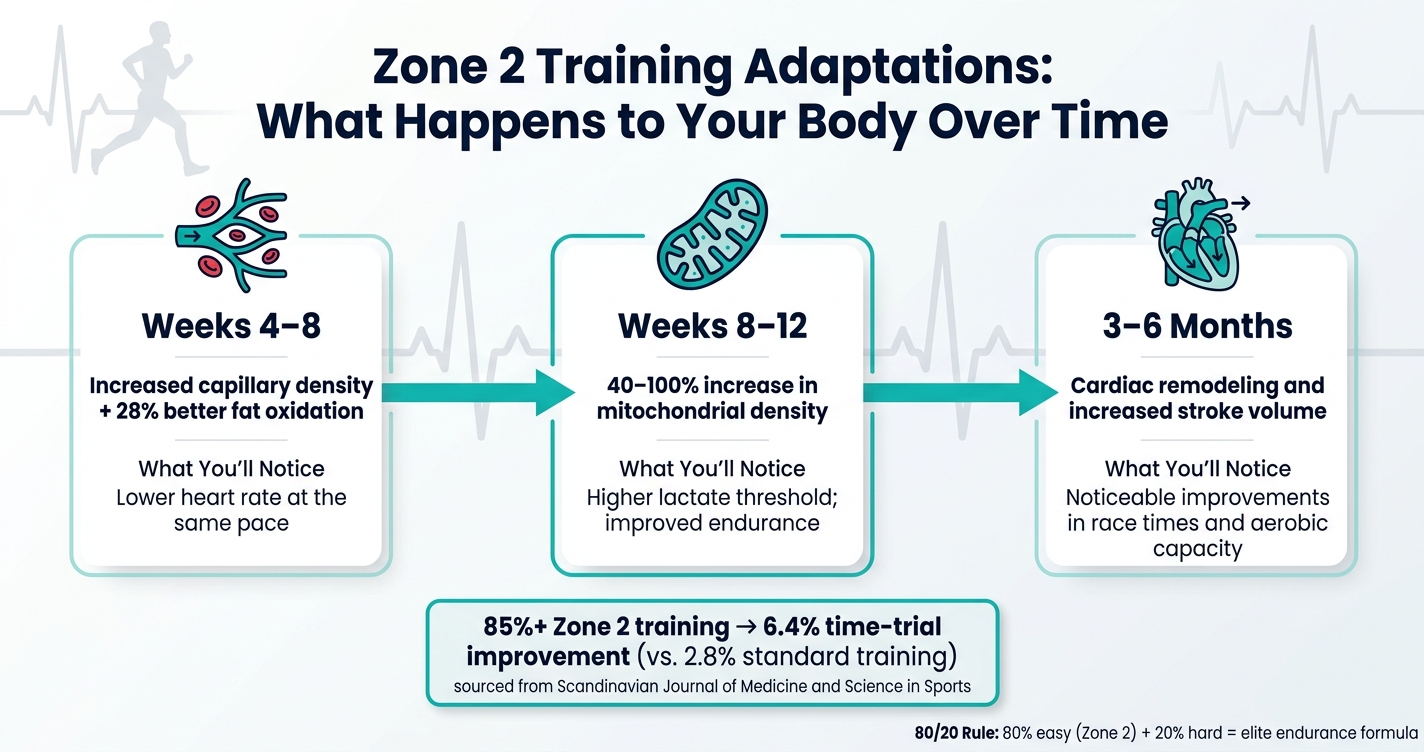
Zone 2 Training Adaptations: What Happens to Your Body Over Time
Sticking with Zone 2 training over time can lead to impressive results. A study in the Scandinavian Journal of Medicine and Science in Sports followed well-trained cyclists for 12 weeks. The group that devoted more than 85% of their training to Zone 2 saw a 6.4% improvement in time-trial performance. In contrast, a group using a standard polarized training approach improved by only 2.8%. For runners, this translates to faster race times with less effort, thanks to better aerobic capacity.
Over a 6–12 week period, consistent low-intensity workouts bring about key physiological changes. Mitochondrial density increases, your heart becomes more efficient - pumping more blood with each beat - and your muscles get better at burning fat, conserving glycogen for when you need it most. These adaptations also raise your lactate threshold and enhance your ability to clear lactate, allowing you to push harder for longer before fatigue sets in.
Here’s a breakdown of what to expect as your body adapts:
| Timeline | Key Adaptation | What You'll Notice |
|---|---|---|
| Weeks 4–8 | Increased capillary density; 28% better fat oxidation | Lower heart rate at the same pace |
| Weeks 8–12 | 40–100% increase in mitochondrial density | Higher lactate threshold; improved endurance |
| 3–6 Months | Cardiac remodeling and increased stroke volume | Noticeable improvements in race times and aerobic capacity |
These gradual changes create a strong foundation for improved performance across all areas of endurance training.
Dr. Peter Attia sums it up well:
"Zone 2 is the most important exercise you're probably not doing."
The 80/20 rule - spending 80% of your training in Zone 2 and 20% on high-intensity efforts - has been a cornerstone for elite endurance athletes for years. While the first 4–8 weeks of low-intensity training might feel slow and unexciting, the aerobic base you’re building during those sessions is what makes every other workout more effective.
Most runners begin to notice improvements after 8–12 weeks of sticking to consistent Zone 2 training. Early changes, like running faster while maintaining the same heart rate, might show up within a few weeks. However, the more noticeable gains usually take about 2–3 months to emerge. It’s important to stay patient - Zone 2 adaptations take time to fully develop.
When your heart rate climbs on hills or during hot weather, it’s better to focus on how you feel rather than fixating on the numbers on your watch. In the heat, slow your pace and use the talk test - if you can carry on a full conversation, you’re working at the right intensity. On hills, it’s okay to slow down, take walking breaks, or let your heart rate spike briefly on steep climbs. Pay attention to your breathing and perceived effort, prioritizing those over rigid heart rate goals.
No, you don’t need a chest strap for Zone 2 training. While heart rate monitors can be helpful, there are simpler ways to gauge your effort. One common approach is the talk test - if you can carry on a conversation in full sentences without struggling for breath, chances are you’re in Zone 2. You could also try breathing exclusively through your nose or alternating between running and walking to maintain a steady, moderate intensity.


.svg)
