Yes, you can keep exercising and still see the scale stall. The short answer is simple: after early weight loss, your body often starts using less energy, you may move less outside workouts, and appetite can climb. That mix can flatten weight change even when effort stays high.
Here’s the core of what I’d want you to know right away:
A few study results make this clear:
| Focus | What studies show |
|---|---|
| Resting metabolism | Often drops more than expected after weight loss |
| Daily movement | Often falls, which cuts total daily calorie burn |
| Appetite | Can rise and offset workout calories |
| Aerobic exercise | Good for fat loss, but compensation is common |
| Resistance training | Helps keep muscle and supports resting metabolism |
| HIIT | Strong effect on visceral fat with lower training volume |
| Combined training | Good mix of fat loss, fitness, and lean-mass support |
If I had to sum up the whole article in one line, it would be this: weight plateaus during exercise are usually not about “failing” - they’re often the result of normal energy-saving changes in the body and behavior.
After weight loss, the body often burns fewer calories than you’d expect. That’s a big reason plateaus are so common. Even when someone keeps exercising, progress can slow because the body starts using less energy.
When you lose weight, resting energy expenditure, or REE, goes down. That part is normal. A smaller body needs less energy at rest.
But here’s where things get tricky: the drop in REE is often bigger than body size alone should explain. This is called adaptive thermogenesis. In plain English, measured REE ends up lower than predicted REE.
One 16-week clinical trial looked at 131 Chinese adults with overweight or obesity, with an average age of 33.3. Participants followed a high-protein meal replacement plan and aimed for 10,000 steps per day. They still lost an average of 5.6 kg. Even so, the gap between measured and predicted RMR fell across follow-up visits in a statistically meaningful way (p < 0.05), which points to metabolic adaptation. Other studies show a similar pattern. In a 12-week aerobic study, 43% of participants had a larger-than-expected drop in REE.
Resting metabolism is only one piece of the story. Daily movement and exercise can shift too.
The body can also get better at movement after weight loss. That may sound like a good thing, but it can work against fat loss. If movement economy improves, the same activity may burn fewer calories than it did before.
At the same time, non-exercise activity thermogenesis, or NEAT, often drops as the body tries to conserve energy. So even if planned exercise stays the same, total daily energy burn may not stay as high as expected. The constrained energy model explains this idea: extra exercise can be partly offset by a drop in NEAT, which leads to smaller-than-expected increases in total daily energy expenditure, or TDEE.
"The body adapts to increased exercise by reducing energy spent on other activities... resulting in smaller-than-expected increase in TDEE following additional exercise." - Eylam Ziv Av, Frontiers in Nutrition
| Metabolic Feature | Expected Change | Adaptive Change During Plateau |
|---|---|---|
| Resting Energy Expenditure (REE) | Drops proportionally to body mass lost | Drops more than mass loss predicts |
| Movement Efficiency | Stays relatively stable per unit of work | Improves; fewer calories burned for the same activity |
| Daily Energy Burn (TDEE) | Stays elevated if exercise volume is maintained | Often lower than predicted due to NEAT reductions |
Put together, these shifts help explain why plateaus often show up after the early stage of weight loss.
Most plateaus show up within 6 to 12 months of weight loss, and most weight loss tends to happen in the first 6 months. After that, body weight often starts to level off because the compensation keeps going.
Research also suggests that metabolic adaptation is strongest during active calorie restriction and may ease once weight stabilizes. Still, results differ based on the group being studied, how long the program lasted, and how much weight was lost.
These shifts don’t look the same in every kind of training. Aerobic, resistance, and HIIT studies often report different plateau outcomes, which leads straight to the next issue: which exercise changes can help counter them?
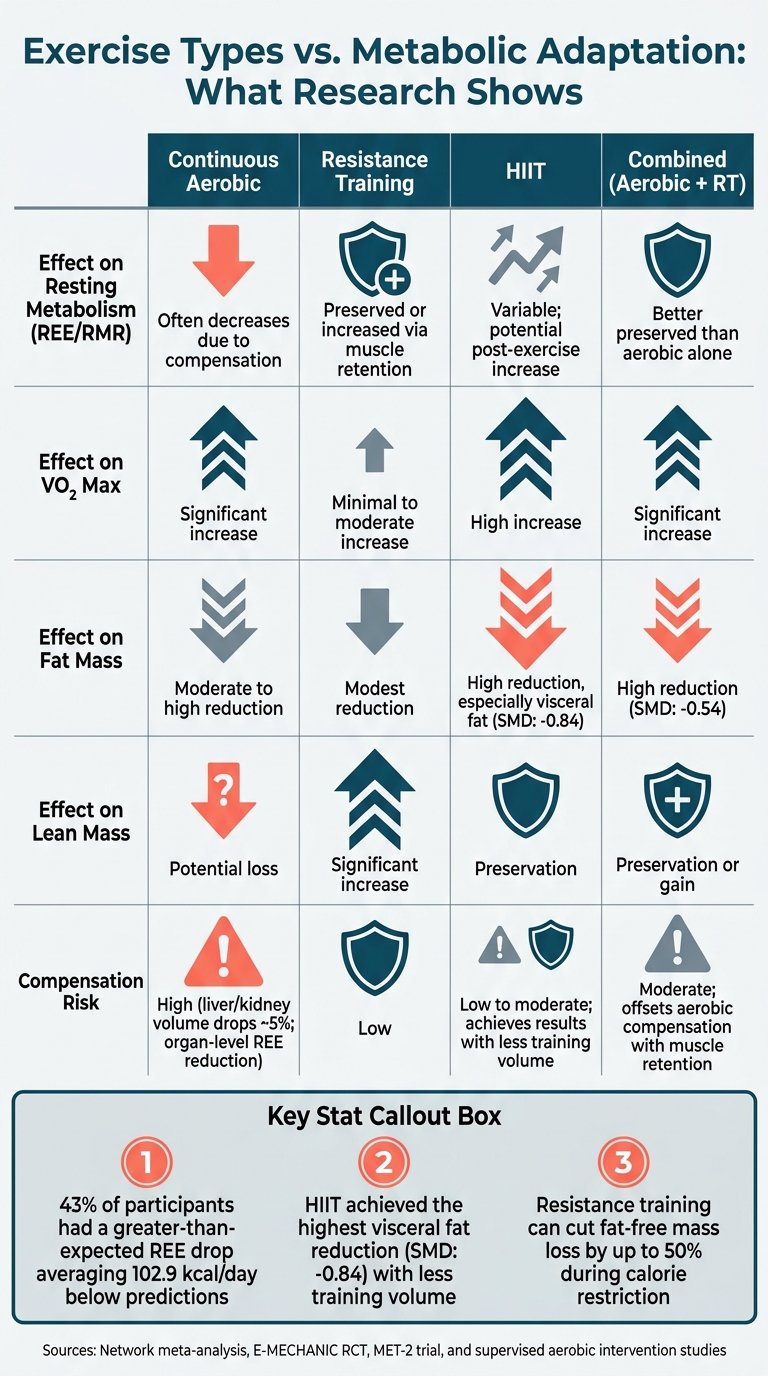
Exercise Types vs. Metabolic Adaptation: What Research Shows
The main issue isn't whether exercise helps. It does. The tougher question is which kind of exercise does the most to limit metabolic compensation.
That matters because exercise choice affects what the body does next. It can burn more energy, hold on to lean mass, or push the body to cut energy use in other places.
Continuous aerobic exercise burns calories and improves cardiovascular fitness. But there's a catch: the body often makes up for part of that extra effort by spending less energy elsewhere.
So while aerobic training can help with fat loss, it can also trigger compensation that puts a ceiling on total energy expenditure and weight loss. In one 12-week aerobic intervention, liver and kidney volumes dropped by about 5%, which may reduce resting energy expenditure.
That helps explain why calorie burn alone isn't always enough. It also shifts the focus toward resistance training, which does a better job of protecting lean mass during weight loss.
The big win with resistance training is that it helps preserve fat-free mass, which supports resting metabolic rate.
During diet-driven weight loss, about 25% of the weight lost can come from fat-free mass. Adding exercise can cut that loss by up to 50%. Resistance training also supports muscle growth, which can increase basal metabolic rate and improve insulin sensitivity.
Aerobic training still leads to greater fat loss in absolute terms. In programs lasting at least 10 weeks, it produced 1.82 kg more fat loss than resistance training. But if the main goal is to protect metabolic rate while losing weight, resistance training has a clear edge.
That’s where HIIT and combined training come in. They aim to get more fat loss without giving up as much metabolic support.
HIIT showed the strongest effect on visceral fat. A network meta-analysis found that HIIT had the largest reduction in visceral adipose tissue (VAT), with a standardized mean difference (SMD) of -0.84. That compared with -0.54 for combined aerobic-plus-resistance programs and -0.53 for aerobic exercise alone.
What makes that stand out is the dose. HIIT reached this effect with less training volume than aerobic or combined programs.
Combined programs - aerobic exercise plus resistance training - sit in a useful middle ground. They can deliver meaningful fat loss, solid VO₂ max gains, and better lean mass preservation than aerobic training alone.
| Exercise Type | Effect on REE/RMR | Effect on VO₂ max | Effect on Fat Mass | Effect on Lean Mass |
|---|---|---|---|---|
| Continuous Aerobic | Often decreases due to compensation | Significant increase | Moderate to high reduction | Potential loss |
| Resistance Training | Preserved or increased via FFM retention | Minimal to moderate increase | Modest reduction | Significant increase |
| HIIT | Variable; potential post-exercise increase | High increase | High reduction, especially visceral fat | Preservation |
| Combined (Aerobic + RT) | Better preserved than aerobic alone | Significant increase | High reduction | Preservation or gain |
This difference matters a lot when someone is trying to break a plateau, not just pile on more exercise. The next step is figuring out which changes in training can help offset these metabolic shifts once progress starts to stall.
When weight loss stalls, studies usually look at two main fixes: do more exercise or cut down on compensation. In plain English, that means researchers want to know whether a plateau changes when people add more training volume or move more during the rest of the day.
Studies on higher exercise volume show a pretty stark split between responders and nonresponders.
In the Midwest Exercise Trial 2 (MET-2), a 10-month supervised study of 74 adults burning 400–600 kcal per session, responders lost an average of 8.4% of body weight and 8.6 kg of fat mass. Nonresponders, by contrast, changed by just -0.04%. The big difference was not resting metabolism. It was behavior outside the workout: responders increased non-exercise physical activity by 38 minutes per day.
The E-MECHANIC randomized controlled trial, a 24-week study of 198 adults, found something similar. The high-dose group, set at 20 kcal/kg/week, showed 2.7 kg of compensation. The lower-dose group, at 8 kcal/kg/week, showed 1.5 kg. So more exercise did not automatically mean more weight loss. In some cases, it came with more compensation.
"Compensation resulted from increased energy intake and concomitant increases in appetite... Compensation was not due to activity or metabolic changes." - The American Journal of Clinical Nutrition
Here’s the quick snapshot of what these study designs found in people at or near a plateau:
| Study Design | Sample | Change in REE/RMR | Change in Weight/Fat Mass |
|---|---|---|---|
| 10-month supervised exercise, 400–600 kcal/session | 74 adults with overweight/obesity | No significant change in RMR | Responders: -8.4% weight, -8.6 kg fat; Nonresponders: -0.04% weight |
| 12-week supervised aerobic walking, 20 kcal/kg/week | 16 sedentary adults with overweight | RMR and sleeping metabolic rate decreased | Minimal weight loss; improved body composition |
| 24-week RCT (E-MECHANIC) | 198 adults | No significant metabolic slowing | Less weight lost than predicted due to increased intake |
That shifts attention to a less obvious factor: what people do during the rest of the day may matter as much as, or more than, the workout itself.
Research keeps pointing to NEAT as a key part of the plateau story. In MET-2, responders increased non-exercise physical activity, while nonresponders did not. Nonresponders also had higher energy intake.
"Men who did not lose weight in response to exercise (<5%) had higher energy intake and lower NEEx when compared with men losing ≥5%." - Joseph E. Donnelly, Department of Internal Medicine, University of Kansas Medical Center
That’s an important distinction. The separating line was not just the exercise plan on paper. It was the extra daily movement around it.
Small shifts in day-to-day movement can add up, but they’re easy to miss without close tracking. That’s why plateau studies need precise activity data, especially when compensation shows up in small, hard-to-spot ways.
To tell the difference between a true physiological plateau and simple lower adherence or lower intake, researchers rely on several objective measures. That matters because a slower metabolism, eating less than reported, and moving less during the day can all lead to the same thing on the scale.
DEXA scans measure fat mass and fat-free mass. Researchers use those numbers in models that predict resting energy expenditure. When measured energy expenditure falls meaningfully below that predicted level, they classify it as metabolic adaptation - a drop in energy expenditure that goes beyond what body-composition changes alone would predict.
Researchers also try to rule out poor adherence. In supervised exercise studies, they track sessions directly and use real-time heart-rate monitoring. In some trials, adherence rates reached 95%. To estimate energy intake, many studies use the intake-balance method, which works backward from changes in body composition and total daily energy expenditure measured with doubly labeled water.
Each method covers a different piece of the plateau story, which we explore further on The Benchmark Blog:
| Measurement Tool | What It Quantifies | Common Use in Research |
|---|---|---|
| DEXA / DXA | Fat mass and fat-free mass | Assessing body composition changes and predicting expected metabolic rate |
| Indirect Calorimetry | O₂ consumption and CO₂ production | Measuring resting metabolic rate, sleeping metabolic rate, and diet-induced thermogenesis |
| Doubly Labeled Water | Total daily energy expenditure | Measuring free-living energy burn and compensation |
| VO2 max Testing | Peak oxygen uptake and cardiorespiratory fitness | Calibrating exercise intensity and identifying responders vs. non-responders |
| Blood Panels | Hormonal signals linked to appetite and metabolic slowing | Tracking leptin, thyroid hormones, and insulin during weight loss |
| Accelerometry | Non-exercise physical activity (NEAT) | Distinguishing true metabolic adaptation from reduced daily movement |
With these tools, studies have shown that metabolic adaptation can be measured. It is not just a guess. In one supervised exercise trial, 43% of participants had a greater-than-expected drop in REE, averaging 102.9 ± 77.5 kcal per day below predictions. That is a small daily number on paper, but over time it can make progress feel like it has stalled.
There is also an organ-level piece to this. The brain, liver, and kidneys make up only about 5% of body weight, yet they account for about 51% of total resting metabolic rate. Research also shows that liver and kidney volume can fall by about 5% during aerobic exercise interventions. That helps explain why plateaus are hard to read from body weight alone. The body is not just “burning less” in a vague sense; part of the shift may reflect changes in tissues that use a lot of energy.
"Aerobic exercise training engages compensatory physiological and behavioral mechanisms that constrain energy expenditure." - Nature Communications
Two big questions are still unsettled. Researchers do not yet know why exercise responses differ so much from one person to another. They also have not pinned down the exact timeline for when adaptation peaks, though current thinking places it somewhere between one and three months.
Your weight may plateau because your body is set up to guard its energy balance through energy compensation.
Here’s the simple version: when you exercise, your body may respond by cutting back energy use somewhere else. It can lower your resting calorie burn, make your movements more efficient, and use less energy for other processes.
So even if a workout says you burned a certain number of calories, your total daily burn may not go up by that full amount. Because of this, only about 72% of exercise calories burned may increase total daily energy expenditure.
To break a weight plateau, focus on strength training before you pile on more cardio. That’s often the smarter move.
Why? Strength work helps you keep lean muscle. And lean muscle supports a higher resting metabolic rate, which means your body burns more calories even when you’re not working out.
If you already lift, take a close look at your routine. You need a clear progression plan. That could mean adding weight, doing more reps, improving form, or increasing training volume over time. Without progression, it’s easy to stall.
If you do strength training and cardio in the same session, try lifting first. In many cases, doing strength work before cardio may help with fat-loss efficiency.
A weight-loss plateau often comes from more than one thing happening at the same time.
Metabolic adaptation is one common reason. It’s more likely when your weight stays flat for two to three weeks even though you’ve been tracking your intake and routine the same way the whole time. You might also notice a few other signs: lower energy, feeling colder, and stronger hunger.
Appetite or tracking drift is another big one. In plain English, that often means you may be eating more than you think, even if it doesn’t feel like much. Small extras can add up fast.
Then there’s lower daily movement. This usually shows up outside your workouts, not during them. You may fidget less, move a bit more slowly, or spend more time sitting without noticing it.


.svg)
