If I want to know whether I’m losing fat, keeping muscle, and carrying extra visceral fat, a DEXA scan gives me a much clearer answer than why your scale is lying to you or BMI.
Here’s the short version: DEXA shows body fat, lean mass, visceral fat, and bone density in one scan. That makes it useful for fat loss, training, bone checks, and spotting hidden metabolic risk. In most cases, a scan costs about $75 to $200 in the U.S., and many people repeat it every 3 to 6 months when they want to track change.
What stands out most to me:
A few numbers from the article matter:
If I only care about scale weight, I may not need a DEXA scan. But if I want a baseline for fat loss, performance, healthy aging, or bone health, it can give me data I can actually use.
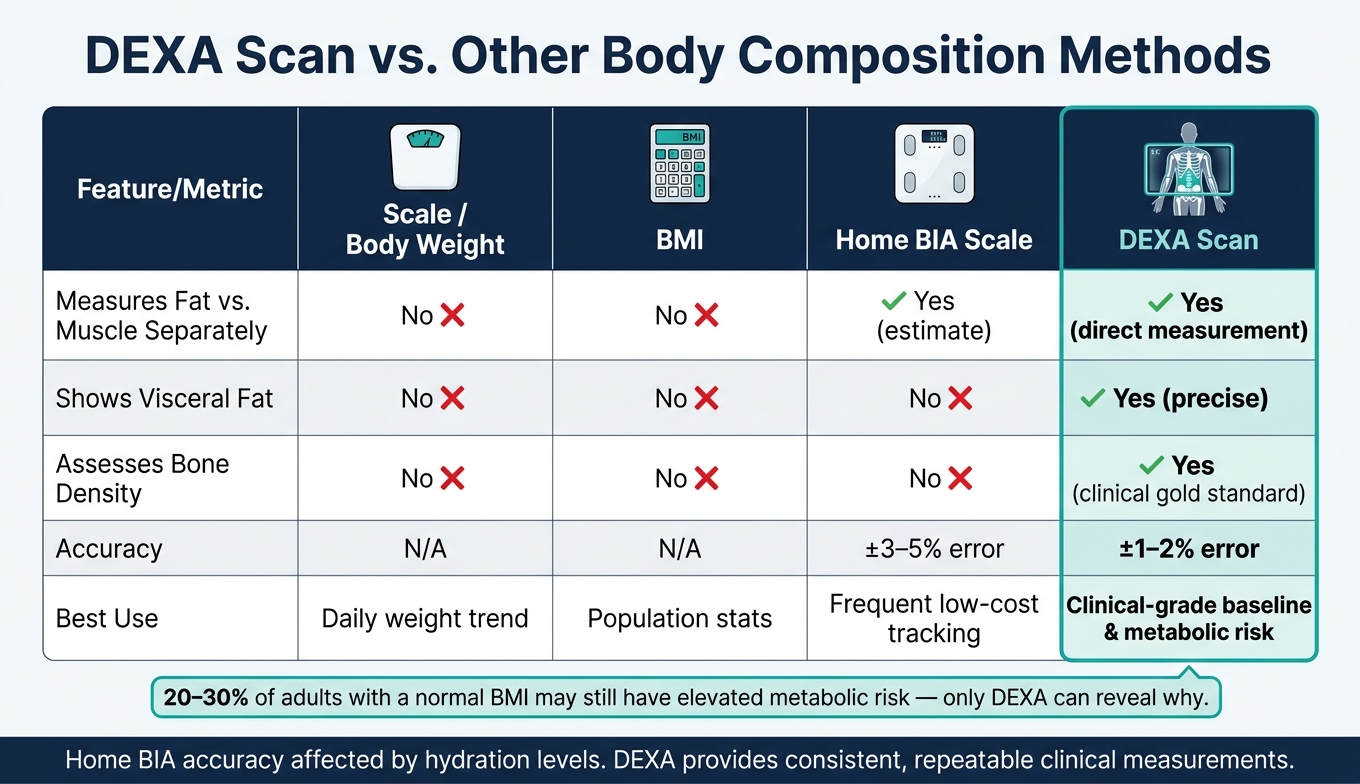
DEXA Scan vs. Other Body Composition Methods: What Each One Actually Measures
A DEXA (Dual-Energy X-ray Absorptiometry) scan uses low-dose X-rays to separate fat, lean tissue, and bone with clinical precision. Put simply, it shows what your body weight is made of, not just what the scale says.
That matters because body-composition tracking becomes much more practical when the numbers tell you what changed. Did you lose fat? Did you lose muscle too? Is bone health a concern? DEXA helps answer those questions.
DEXA gives you four core outputs, and each one points to a different part of the health picture.
Total body fat percentage is measured at ±1–2% clinical accuracy, which is tighter than the ±3–5% range common with home BIA scales. DEXA also breaks fat down by body region, including the arms, legs, and trunk. So if your weight changes, you can see whether that change came from fat, muscle, or a mix of both.
Lean mass shows how much of your body is made up of non-fat tissue, mainly muscle. This is one of the biggest reasons DEXA stands out. A regular scale can't tell the difference between losing 10 pounds of fat and losing 10 pounds of muscle. DEXA can.
Visceral adipose tissue (VAT) is the fat stored around your internal organs. You won't see it in BMI, and your bathroom scale won't pick it up either. DEXA measures visceral fat directly, which makes it useful for checking markers tied to metabolic and cardiovascular risk.
Bone mineral density (BMD) is reported as T-scores and Z-scores to assess bone strength and fracture risk. DEXA is the clinical gold standard for diagnosing osteopenia and osteoporosis. So this scan is not just about weight change. It also gives you data tied to long-term bone health.
Here’s the practical difference between the most common methods.
| Method | Measures fat vs. muscle separately | Shows visceral fat | Assesses bone density | Best use |
|---|---|---|---|---|
| Weight/Scale | No | No | No | Daily weight trend monitoring |
| BMI | No | No | No | Population-level health statistics |
| Home BIA Scale | Yes (estimate) | No | No | Frequent, low-cost trend tracking |
| DEXA Scan | Yes (direct measurement) | Yes (precise) | Yes (clinical gold standard) | Clinical-grade baseline and metabolic risk tracking |
Home BIA readings can shift with hydration, which makes them less steady for tracking true change. That’s where DEXA comes in. If a scale gives you the headline, DEXA gives you the full box score.
A scale gives you one number. DEXA shows what changed inside that number.
That difference matters because it can point to specific problems you can do something about.
DEXA can show whether stalled weight change came from fat loss, muscle gain, or a mix of both. It clears up the confusion by separating fat mass from lean mass.
Say you lost 4 pounds but gained lean mass in your legs. That's still a win, even if the scale barely budged. On the flip side, if your weight dropped and muscle dropped too, that's a sign to adjust your protein intake or training load before it turns into a bigger issue.
Regional results add another layer. They show where muscle is dropping or improving. For example, losing leg muscle while keeping trunk mass can chip away at strength and performance over time, even when your top-line numbers seem fine.
That's why DEXA is useful for people who want to lose fat without giving up muscle.
About 20–30% of adults with a "normal" BMI may still have metabolic risk profiles usually linked with obesity. In plain terms, you can look lean and still carry enough visceral fat to put your health at risk.
Visceral fat is metabolically active. It releases inflammatory compounds that interfere with insulin signaling and increase the risk of type 2 diabetes and cardiovascular disease. Research also links high visceral fat to a 2.26-fold increased risk of future diabetes.
DEXA measures visceral fat directly. If your scan shows high levels, that can serve as an early warning. From there, you may have a clearer reason to focus on resistance training, better sleep, diet changes, and medical follow-up.
That kind of detail matters even when your body weight looks normal.
Two common age-related issues - bone density loss and muscle loss (sarcopenia) - often stay hidden until a fracture or fall happens. DEXA can flag low bone density and falling lean mass before symptoms show up or an injury forces the issue.
Low skeletal muscle mass is associated with a 1.44-fold higher risk of all-cause mortality. So this isn't just about gym performance. It also ties into long-term health.
When a scan shows declining lean mass or low bone density, the next move is easier to see. That might mean putting more focus on resistance training and talking with your doctor about calcium, vitamin D, or more clinical follow-up.
Next, the question becomes who benefits most from a scan.
A DEXA scan makes sense when the result will change what you do next with training, nutrition, or health screening.
If your goal is fat loss without giving up muscle, DEXA can show whether your plan is changing body composition, not just the number on the scale. That matters a lot for people with a normal BMI but higher body fat. Research suggests 20–30% of "normal weight" adults have metabolic profiles that put them at elevated risk for disease. In plain English: you can look “fine” by BMI and still have a body fat pattern that deserves a closer look.
Athletes and serious recreational athletes also get a lot from DEXA. It tracks regional lean mass and muscle symmetry, so you can see if one side is lagging, if a limb is losing muscle more slowly, or if a training block is shifting mass the way you planned. That’s hard to spot from photos, scale weight, or even gym performance alone.
For adults over 40, DEXA can help flag bone and muscle loss early, before it turns into a bigger issue. Postmenopausal women, in particular, may use it to watch T-scores and lean mass over time.
It’s also a smart option for people with a family history of type 2 diabetes, cardiovascular disease, or osteoporosis. DEXA explains fat distribution and lean mass directly, which gives a clearer picture than body weight by itself.
Once the use case is clear, the big practical questions are cost and timing.
A body composition DEXA scan usually costs $75–$150, though some centers charge as much as $200. In the U.S., body composition scans are usually self-pay. Bone density testing, however, may be covered by insurance when it’s medically necessary, such as for osteoporosis screening.
How often to scan depends on your goal. One scan gives you a snapshot. A series of scans shows the pattern, and that’s usually what matters most.
| Goal | Primary DEXA Metrics | Typical Follow-up Interval | When It Makes Sense |
|---|---|---|---|
| Fat Loss / Recomposition | Body Fat %, Visceral Fat (VAT), Lean Mass | Every 3–6 months | To confirm fat is dropping without muscle wasting. |
| Athletic Performance | Regional Lean Mass, Symmetry, Lean Mass | 2–4 times per year | Pre-season, mid-season, and post-season tracking. |
| Longevity (Age 40+) | Lean Mass Index, Bone Mineral Density | Every 6–12 months | To track muscle loss and maintain bone health. |
| Medical Risk / Bone Health | T-score, Z-score, Visceral Fat (VAT) | Every 1–2 years | For postmenopausal women or those with a family history of osteoporosis. |
To make repeat scans useful, keep the conditions as similar as possible each time: same time of day, same meal timing, and similar hydration. A single number can bounce around. The trend across scans is what gives the scan its value.
DEXA gives you the starting point for body composition. After that, the next step is to pair it with tests that explain fitness, metabolism, and health risk. Each one answers a different question. The payoff comes when you read them together.
| Service | How it complements DEXA |
|---|---|
| DEXA Scan | Baseline body composition and bone health |
| VO2 Max Test | Shows how body composition relates to heart and lung efficiency |
| Metabolic Testing (RMR) | Uses lean mass data to refine calorie targets |
| Blood Panels | Provides biochemical evidence for the metabolic risks suggested by visceral fat levels |
Put together, these tests link body composition, fitness, metabolism, and blood markers into one practical framework for decision-making. That matters because a person can have a normal BMI and still carry high visceral fat. On paper, they may look fine. In practice, their combined risk may be higher. Routine physicals can miss that pattern, but this mix of tests can show it much more clearly.
Weight and BMI give you one number. DEXA gives you the breakdown: how much fat you carry, where that fat is stored, how much lean mass you have, and how your bone health is changing over time. If you're trying to make decisions about training, nutrition, or long-term health, that extra detail makes a big difference.
A DEXA scan makes the most sense when you have a clear question to answer. That could mean checking whether fat loss is coming from fat instead of muscle, spotting hidden visceral fat risk, tracking bone density over time, or building a full health baseline. One scan gives you a starting point. For most people, 2 to 4 scans per year - about every 3 to 6 months - is enough to show whether your interventions are working.
"You cannot manage what you cannot measure. A DEXA scan gives you the baseline - and every follow-up scan tracks exactly how your interventions are working in real numbers." - Chris Brubaker
The value of DEXA is simple: it turns body weight into data you can use. When you pair it with VO2 Max, metabolic testing, and blood panels, you get a clearer picture for training, nutrition, and long-term health.
Yes. A DEXA scan is considered safe.
It does use ionizing radiation, but the dose is very low - about one-tenth of a standard chest X-ray and less than spending eight hours outside on a sunny day.
Because the exposure is so small, DEXA scans are generally safe to repeat. That said, experts often suggest limiting them to two to four times per year.
The scan itself is short and simple. It usually takes about 7 to 15 minutes, and you lie still on an open table during the test.
Wear light, comfortable clothes and skip anything with extra metal, like zippers, buttons, or jewelry. Before the scan, take off watches, belts, and electronics.
For more consistent results over time, try to book your scans for the same time of day and stick to a similar eating pattern beforehand. It also helps to avoid hard exercise for 12 to 24 hours before your scan.
Look past the total number on the scale. Your DEXA report shows fat mass, lean muscle mass, and bone mineral density, with regional data for your arms, legs, and trunk.
Pay close attention to lean muscle distribution, visceral fat, and bone mineral density T-scores. If you want to track progress, compare each scan with your past results and test under the same conditions each time. Our trained experts will walk you through what the numbers mean for your health goals.


.svg)
