Yes - if you want a clear picture of your fitness and long-term health, a VO2 max test is worth it. It shows how well your body uses oxygen during hard exercise, which body weight, BMI, resting heart rate, and standard lab work do not show. Research in the article links higher cardiorespiratory fitness with much lower risk of early death, with figures like about 50% lower risk when moving from very low fitness to average, and nearly 70% lower risk when moving from low fitness to above-average fitness.
Here’s the short version:
If I wanted one number that connects exercise performance with health risk, VO2 max would be high on the list. It gives me a starting point, shows if training is working, and helps me make better exercise choices without guessing.
| Metric | What it tells me | What it does not tell me | Use for aerobic fitness |
|---|---|---|---|
| VO2 max | How much oxygen my body can use at hard effort | Strength or flexibility | High |
| Weight / BMI | Body size | Fitness under effort | Low |
| Resting heart rate | Baseline pulse | Peak exercise capacity | Medium |
| Basic blood work | Cholesterol, glucose, lipids | How my body performs during exercise | Low |
So if I want more than a guess about my fitness, a VO2 max test gives me a number I can use to compare my fitness level.
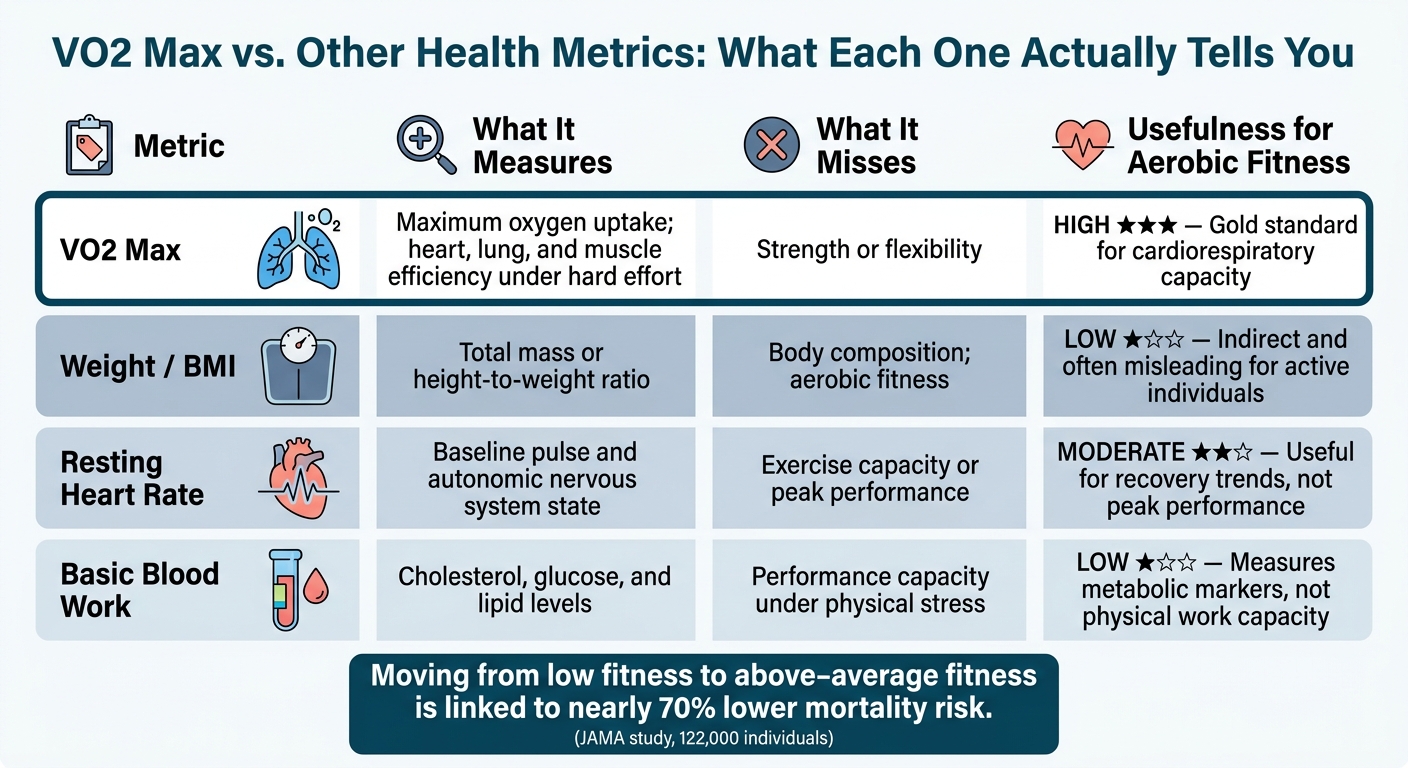
VO2 Max vs. Other Health Metrics: What Each One Actually Tells You
Weight, BMI, and standard labs tell you about body size or blood chemistry. VO2 max tells you something different: how well your body uses oxygen during exercise.
That difference matters more than most people think. Someone can look fine on paper and still have low cardiorespiratory fitness. Why? Because no standard lab marker shows aerobic capacity or cardiovascular efficiency under physical stress. Weight and BMI are indirect stand-ins for health, while VO2 max is a direct measure of cardiorespiratory capacity and aerobic power.
Put simply, VO2 max gets closer to actual fitness than numbers tied only to body composition.
A VO2 max test pushes you to your aerobic limit. It measures how much oxygen your body can deliver and use when the work gets hard.
A higher VO2 max often points to a stronger heart with greater stroke volume, denser capillaries that move oxygen faster, and more efficient mitochondria. In plain English, that can show up as:
The test can also pinpoint training thresholds. That helps you set heart-rate zones with more precision than age-based formulas.
Here’s how VO2 max stacks up against the numbers most people already track.
| Metric | What It Measures | What It Misses | Usefulness for Aerobic Fitness |
|---|---|---|---|
| VO2 Max | Maximum oxygen uptake and use; heart, lung, and muscle efficiency | Strength or flexibility | High - gold standard for cardiorespiratory capacity |
| Weight / BMI | Total mass or height-to-weight ratio | Body composition; aerobic fitness | Low - indirect and often misleading for active individuals |
| Resting Heart Rate | Baseline pulse and autonomic nervous system state | Exercise capacity | Moderate - useful for recovery trends, not peak performance |
| Basic Blood Work | Cholesterol, glucose, and lipid levels | Performance capacity | Low - measures metabolic markers, not physical work capacity |
Seen side by side, the gap is pretty clear. VO2 max helps with things like setting training zones and tracking change over time in a way these other metrics just don’t.
Once you know what VO2 max measures, the next step is using it to shape your training and health choices. A lot of people begin a new fitness plan with a rough idea of where they stand: a recent race time, how hard a workout felt, or the number on the scale. The problem is, none of those show how your cardiovascular system performs under load.
A VO2 max test gives you a clear starting point for training, recovery, or checking fitness as you get older. You can use age- and sex-based norms for context, then pay close attention to your own baseline and compare it with future tests. That context matters whether you're just getting started, coming back from an injury, or checking fitness as you age.
Once you have that starting point, you can turn the data into training zones that fit you. The common 220-minus-age formula doesn't account for your actual fitness level or thresholds.
A VO2 max test identifies your Ventilatory Threshold 1 (VT1) and Ventilatory Threshold 2 (VT2). These are the points where effort shifts from comfortably aerobic to harder and less sustainable. VT1 and VT2 help define training zones with more precision than age-based formulas.
In plain English, that means your easy runs are easy enough to build your aerobic base, and your hard intervals land at the right intensity to drive progress. Instead of drifting into that all-too-common middle ground, you spend your training time where it counts. For runners, cyclists, and recreational exercisers, threshold-based zones take a lot of the guesswork out of pacing.
This is where retesting starts to pay off. Your body weight can stay the same for weeks even while your fitness is getting better. A VO2 max retest can show gains in oxygen efficiency, better endurance at the same effort level, and improved cardiovascular capacity before you see any visible change in body composition.
A simple schedule works well here:
This is especially useful for runners, cyclists, adults over 40, and anyone getting back into exercise after time off.
VO2 max isn't just a training metric. It also helps show who may face more health risk over time.
Most checkups look at resting markers like cholesterol and blood pressure. Those numbers matter. But they don't tell you how well your heart, lungs, and blood vessels work when your body is under stress. VO2 max helps fill that gap.
A study of 122,000 individuals published in JAMA found that people with elite VO2 max levels had the lowest risk of death, regardless of age or pre-existing conditions. Higher aerobic fitness is also linked to better metabolic regulation, improved insulin sensitivity, and better vascular health.
A low VO2 max score can point to higher health risk. A score below 25 mL/kg/min places someone in the high health risk category.
That number matters most when it leads to action. Think of it like a dashboard light in your car. The warning itself isn't the point. What you do next is.
If your score is low, start by building an aerobic base with Zone 2 cardio. If you're already fit, add 1–2 HIIT sessions per week. The test gives you a clear next step instead of a vague sense that you should "exercise more."
At Benchmark Body Metrics, you can pair VO2 max with DEXA, metabolic testing, and blood panels to connect fitness, body composition, fuel use, and cardiometabolic health.
Instead of looking at one number in isolation, you get a more complete view of how your body is performing in a single visit.
So, is a VO2 max test worth it?
For most people, yes.
A normal body weight and standard lab work don't tell you much about aerobic fitness. VO2 max does. And it predicts long-term health risk better than cholesterol, BMI, or blood pressure. That's a big deal. It also gives you a starting point for fitness, heart-rate zones based on your body, and a clear way to measure progress over time.
The health upside isn't small either. Moving from low fitness to above-average fitness is linked to nearly a 70% lower mortality risk. In plain English: one test can help shape your training, show whether it's working, and point to risk sooner.
This kind of data can help a lot of people, including:
At Benchmark Body Metrics, you can pair a VO2 max test with DEXA, metabolic testing, or blood panels for a better look at body composition testing methods, fuel use, and cardiometabolic health. It's also HSA/FSA eligible.
At the end of the day, the value is pretty simple: VO2 max turns fitness from a guess into a number you can use.
A VO2 max test is a structured, non-invasive assessment done in a controlled lab setting to measure your cardiovascular capacity.
After pre-test screening and equipment calibration, you wear a heart rate monitor and a mask connected to a metabolic analyzer. Then you complete a graded exercise test on a treadmill or bike, with the intensity going up in stages until you reach exhaustion or your oxygen use levels off. After that, you move into a cool-down.
For the most accurate results, skip intense workouts, alcohol, caffeine, and tobacco for 24 to 48 hours before your test. Drink plenty of water, eat balanced meals, stay away from heavy or greasy foods, and get eight hours of sleep the night before.
On test day, eat a light meal at least two hours in advance. Wear lightweight athletic clothing and the proper shoes for your test, and leave jewelry or bulky accessories at home.
There isn’t one good VO2 max score that fits everyone. Your age and gender matter a lot, so the best way to judge a result is to compare it with age-based benchmarks.
VO2 max usually drops by 5%–10% per decade after age 30. So a score that looks excellent for a 60-year-old might be only average for someone in their 20s. In general, a higher score points to better cardiovascular efficiency and a lower risk of chronic disease.


.svg)
