Losing fat lowers your calorie needs - but that doesn’t mean your metabolism is damaged. My starting point: review 2–4 weeks of weight, food intake, steps, and training before cutting calories again.
Adaptive thermogenesis is the extra drop in calorie burn beyond what changes in body size and composition predict. Body-fat percentage alone can’t tell you whether it’s happening.
Here’s what I focus on:
I treat these trends and tests as guides for adjusting your plan, not proof of lasting metabolic damage.
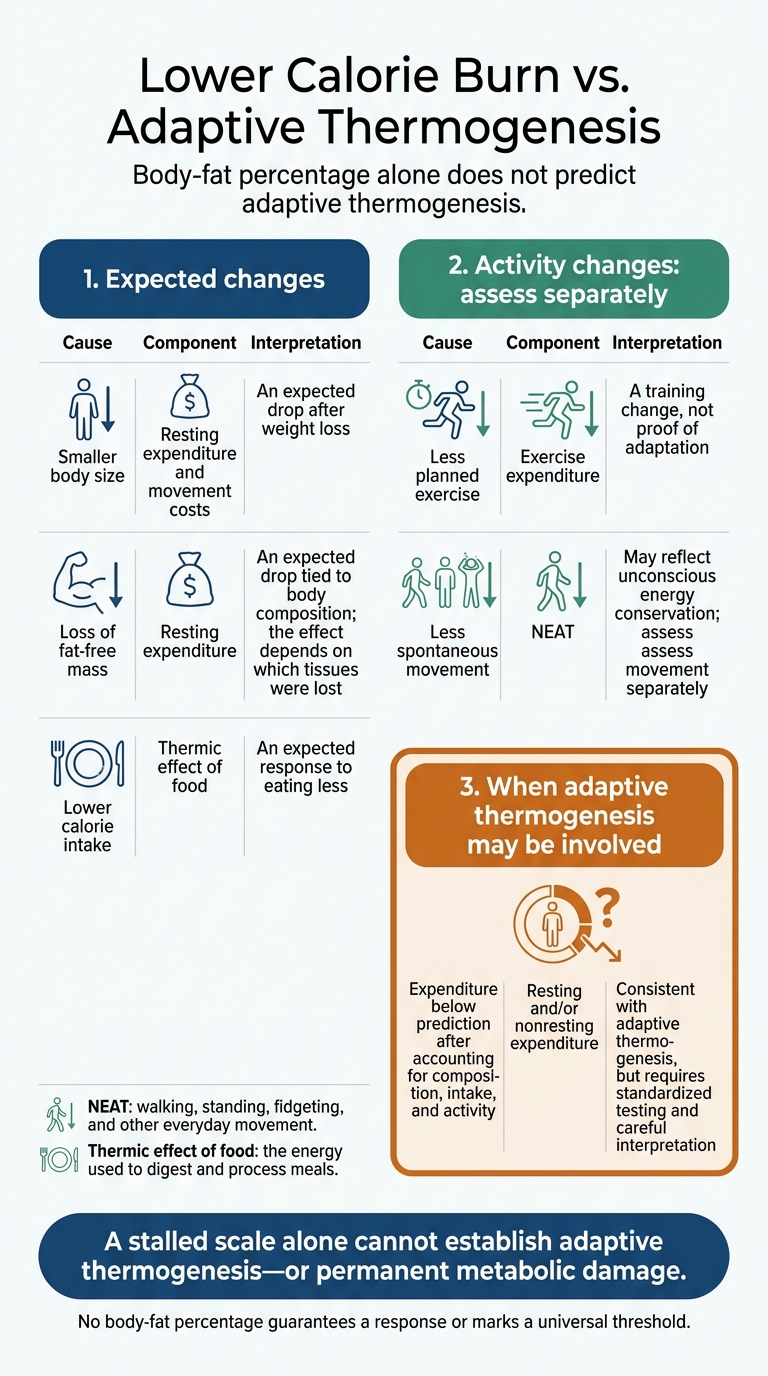
Lower Calorie Burn vs. Adaptive Thermogenesis
Body-fat percentage alone does not predict adaptive thermogenesis. It leaves out total fat mass, fat-free mass, recent calorie intake and weight loss, activity level, and time spent dieting. The key is to separate expected drops in calorie burn from adaptation.
Daily calorie burn comes from resting energy expenditure, the thermic effect of food - the energy used to digest and process meals - planned exercise, and nonexercise activity thermogenesis (NEAT). NEAT covers walking, standing, fidgeting, and other everyday movement.
| Cause of lower calorie burn | Main component affected | How to interpret it |
|---|---|---|
| Smaller body size | Resting expenditure and movement costs | An expected drop after weight loss |
| Loss of fat-free mass | Resting expenditure | An expected drop tied to body composition; the effect depends on which tissues were lost |
| Lower calorie intake | Thermic effect of food | An expected response to eating less |
| Less planned exercise | Exercise expenditure | A training change, not proof of adaptation |
| Less spontaneous movement | NEAT | May reflect unconscious energy conservation; assess movement separately |
| Expenditure below prediction after accounting for composition, intake, and activity | Resting and/or nonresting expenditure | Consistent with adaptive thermogenesis, but requires standardized testing and careful interpretation |
Signals from energy stores can push calorie burn down further.
Fat-free mass isn't just muscle. It also includes organs, bone, connective tissue, and water, so losing it does not cause a fixed drop in calorie burn. Resistance training, enough protein, and a moderate calorie deficit can help preserve lean tissue and limit the expected decline in resting expenditure.
Fat loss lowers leptin. Calorie restriction can also reduce T3 and sympathetic activity. These shifts can affect appetite, movement, resting expenditure, and muscle efficiency. Some studies link greater fat loss to greater adaptation, but no body-fat percentage guarantees a response or marks a universal threshold. Hormone results alone cannot tell you how much adaptation has occurred.
Adaptation can start during active calorie restriction, before someone reaches a low body-fat level, and may persist after weight loss.
Before blaming adaptation for a plateau, review several weeks of weight averages alongside portions, beverages, steps, and training. A smaller body, lean-tissue loss, less movement, and changes in intake can close the calorie deficit. Meanwhile, sodium, carbohydrate intake, menstrual-cycle changes, constipation, and tracking errors can hide progress. A stalled scale alone cannot establish adaptive thermogenesis - or permanent metabolic damage.
To separate these effects, the next step is measuring body composition and resting calorie burn under consistent conditions.
DEXA estimates fat and lean tissue. Indirect calorimetry measures resting energy expenditure (REE) - the calories your body burns at rest. Together, they help show whether resting calorie burn has dropped more than changes in body composition would predict.
Repeat tests provide context the scale alone can’t offer. Compare your measured calorie burn with the amount predicted for your current body composition.
| Metric | Practical use | Main limit |
|---|---|---|
| Body weight | Tracks overall weight trends | Cannot distinguish changes in fat, lean tissue, bone, or fluid |
| DEXA total and regional fat mass | Tracks how much fat changes and where | Estimates depend on the scanner, positioning, and testing conditions |
| DEXA lean soft tissue | Helps track nonfat tissue during weight loss | Includes water, organs, and muscle tissue; is not the same as skeletal muscle or total fat-free mass |
| Visceral fat estimate, where available | Adds context about abdominal fat distribution | Model-based; depends on the scanner and software |
| REE from indirect calorimetry | Compares resting calorie burn with baseline results and predictions | Does not measure total daily energy expenditure |
Hydration can affect DEXA estimates. Indirect calorimetry depends on stable breathing, calibrated equipment, and proper test preparation. And resting calorie burn isn’t your total daily calorie need: movement, exercise, and food digestion use energy, too.
Follow your provider’s instructions on fasting, exercise, caffeine, nicotine, and other stimulants. Schedule repeat tests at roughly the same time of day. Avoid strenuous exercise beforehand, keep hydration and sleep consistent, and arrive rested.
Postpone testing if you have an acute illness. Record anything that could affect results, such as hard training, illness, or menstrual-cycle fluid shifts.
Compare measured REE with a prediction that accounts for body weight, fat mass, fat-free mass, age, sex, and other relevant characteristics. If you have a baseline result, compare against that, too. Ask whether any difference exceeds both the test’s expected variability and the prediction’s margin of error.
Current calorie restriction matters as well. Adaptive thermogenesis is considered only after accounting for expected changes in body composition and other obligatory energy costs. Treat one low REE result as a reason to review testing methods - not as a diagnosis of adaptive thermogenesis.
Use repeat testing only as a baseline for adjusting intake and training.
Benchmark Body Metrics offers DEXA and metabolic testing with clinical-grade equipment. Pair repeat results with 2- to 4-week trends in body weight, intake, steps, training, recovery, and performance.
Once testing shows how calorie burn relates to body composition, use those results to set food intake and activity targets as body fat decreases.
During fat loss, use metabolic efficiency to protect strength, recovery, and daily function - not to chase a higher calorie burn.
Set a moderate deficit based on your current calorie needs, body-fat level, activity, medical history, hunger, and recovery. Skip one-size-fits-all calorie targets.
Include resistance training you can recover from, and spread adequate protein across meals based on your body size and health needs. Keeping lean tissue helps support strength and resting calorie burn, but it does not prevent adaptive thermogenesis.
If weight loss slows, check whether you're moving less and shrinking your calorie deficit. Track steps, exercise, and time spent sitting alongside weekly weight trends. Don't adjust your plan based on a single weigh-in.
Review intake consistency and movement before gradually changing your calorie target. If hunger, fatigue, or poor recovery is getting worse, eating less may be the wrong move.
A maintenance phase means eating near the calories you currently need to maintain your weight instead of staying in a deficit. It can help when dieting makes it harder to follow your plan or recover. But it does not reset metabolism: a smaller body still needs fewer calories.
Keep up resistance training and adequate protein while assessing whether you're ready for more fat loss.
Pause further restriction and seek clinical evaluation for unexplained fatigue or weight changes, persistent dizziness or cold intolerance, menstrual disruption, poor recovery, or repeated injuries.
These symptoms do not prove adaptive thermogenesis. They may stem from underfueling, endocrine issues, anemia, medication effects, or other conditions. Get guidance tailored to your health before cutting intake further.
Fat loss lowers calorie needs. Adaptive thermogenesis is the extra drop beyond what changes in body size and composition explain. Body-fat percentage alone can’t measure this adaptation.
Work to preserve lean mass and keep moving regularly. Calorie needs shift with body fat and lean mass, so review weight, waist circumference, strength, food intake, and activity together over 2–4 weeks. Repeat the same tests under the same conditions, and treat the results as estimates - not final answers.
Adjust calories only after several weeks of trends show a clear pattern. A lower calorie burn is a reason to review those trends, not proof of lasting damage. Adaptive reductions vary and may ease as weight stabilizes.
Metabolic adaptation has no fixed end date. Your resting metabolic rate (RMR) shifts with your body composition, hormone levels, and how long you’ve been in a calorie deficit. These changes can be reversed or managed.
Resistance training and changes to your nutrition may improve metabolic markers within 3 to 6 months. Testing every 8 to 12 weeks helps you track changes and adjust your calorie targets.
Yes, you can still lose fat, but metabolic adaptation makes it harder. Your body saves energy, so your daily calorie burn drops more than weight loss alone would predict.
Avoid drastic calorie cuts. Instead, use resistance training and enough protein to help preserve muscle. Track body composition and resting metabolic rate, then use those measurements to make gradual changes to your food intake and activity - not just follow generic formulas.
Retest your metabolic rate and body composition every 8 to 16 weeks while actively losing weight or changing your routine. These checks help you track changes and spot lean muscle loss. Check-ins every 3 to 6 months are a common standard for keeping calorie targets in line with your weight and metabolism.
Retest sooner if your weight plateaus, you feel persistently tired, or your progress stalls despite consistent effort.