Short answer: not as much as most people think. The “fat-burning zone” usually means exercising at about 60% to 70% of your max heart rate, where your body uses a higher share of fat for fuel. But using more fat during a workout is not the same as losing more body fat over weeks and months.
Here’s the plain-English version:
A common estimate puts the fat-burning zone at 60%–70% of max heart rate. Using the 220 minus age method, a 40-year-old would have an estimated max heart rate of 180 bpm, so that zone would be about 108 to 126 bpm. That can help as a starting point, but it’s still just an estimate.
If I were trying to lose fat, I’d keep it simple: walk more, do cardio I can repeat each week, lift weights, eat enough protein, and track body results like weight trend and waist size.
| Method | What it tends to do | Main trade-off |
|---|---|---|
| Brisk walking / Zone 2 | Higher fat % during exercise, low recovery demand | Takes more time |
| Intervals / HIIT | Higher calorie burn per minute | Harder to recover from |
So if you’re asking, “Should I stay in the fat-burning zone?” my answer is: it can help, but it’s not magic. Use it as a guide, not a rule.
Your body is always burning a mix of fat and carbs. What changes during exercise is the ratio.
The fat-burning zone refers to a low-to-moderate intensity range where fat provides a larger share of the energy used during the workout. People often talk about it alongside Zone 2 training.
Heart-rate zones are often used as a rough way to estimate the fat-burning zone. In most cases, that range is placed at about 60%–70% of your estimated maximum heart rate. A common shortcut for estimating max heart rate is 220 minus your age. So, a 40-year-old would get an estimated max heart rate of 180 beats per minute (bpm), which puts the fat-burning zone at about 108 to 126 bpm.
Still, that number is just a starting point. It’s not built for you as an individual. Your actual fat-oxidation point can be different, and the best way to measure it is through a metabolic exercise test.
At lower intensities, your body can get energy from fat fast enough to keep up with the work. As exercise gets harder, it shifts more toward carbohydrates because carbs can power that effort faster.
That’s the basic idea behind the zone. But here’s the catch: it doesn’t tell you whether exercising in that range leads to more fat loss over time.
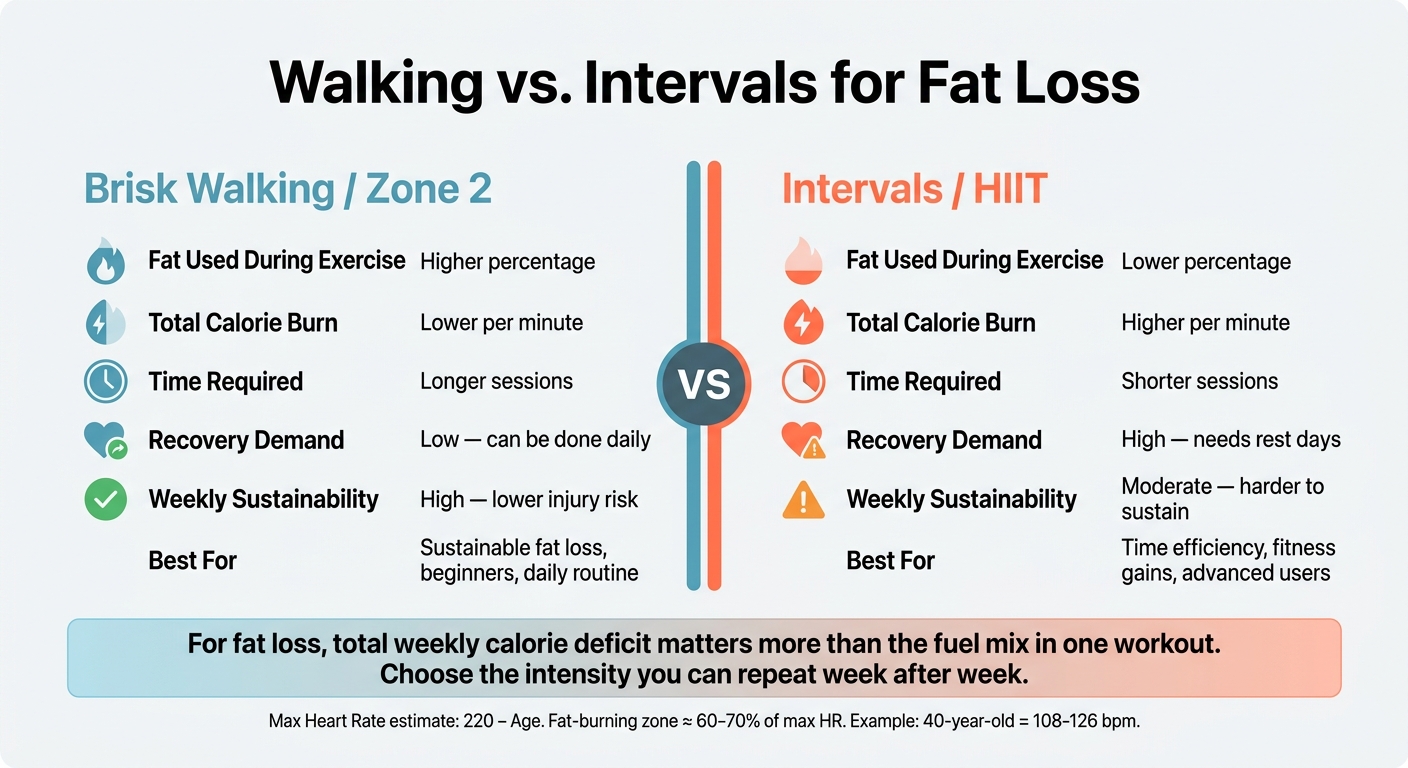
Fat-Burning Zone vs. High-Intensity Cardio: Which Burns More Fat?
The fat-burning zone can help, but it only tells part of the story.
Here’s the key idea: burning a higher percentage of fat during a workout does not automatically mean you’ll lose more body fat over time. What matters more is your overall calorie balance. In plain English, total calories burned and total calories eaten carry more weight than the fuel mix used in one session.
Lower-intensity exercise usually leans more on fat for energy. A harder, shorter workout often uses a lower fat percentage while you’re doing it, but it can burn more total calories. And that can do more to support a calorie deficit.
The main question isn’t which workout burns more fat per minute. It’s which one you can stick with week after week.
| Feature | Walking | Intervals |
|---|---|---|
| Fat used during exercise | Higher percentage | Lower percentage |
| Total calorie burn | Lower per minute; requires longer duration | Higher per minute; efficient for short sessions |
| Time required | Longer sessions | Shorter sessions |
| Recovery demand | Low; can often be done daily | High; requires more recovery |
| Weekly sustainability | Easy to maintain; lower injury risk | Higher effort; harder to sustain long-term |
Walking is easier to fit into daily life. Intervals can get more work done in less time, but they also ask more from your body. That trade-off matters. If a workout looks good on paper but leaves you drained or makes you skip sessions, it’s probably not the best pick for fat loss.
For fat loss, choose the intensity you can repeat often enough to keep a calorie deficit in place.
Fat loss comes from what you do week after week, not from chasing one heart-rate zone every time you train.
A steady routine matters more. So does picking a plan you can keep doing when life gets busy. Cardio can help with calorie burn, and resistance training adds another piece by helping you hold on to muscle mass. Eating enough protein supports that too.
That matters because muscle helps support metabolism, especially when you’re eating in a calorie deficit.
Use heart-rate estimates and wearables as rough guides, not exact measures of fat loss. The point isn't to chase a perfect number. It's to pick an intensity you can stick with. These tools can help you choose cardio you can repeat week after week.
Two common methods can help you estimate your training range: maximum heart rate and heart-rate reserve.
Heart-rate reserve factors in your resting heart rate, so it gives a bit more of a personal estimate than max heart rate alone. Both methods can get you in the right ballpark. But they're still just estimates, and they don't account for all the ways one person's body can react to exercise differently from another's.
Wearables are useful for spotting patterns, but their calorie and fat-burning numbers are still approximations. That readout on your watch isn't a direct measure of body fat lost.
A simple backup tool is the talk test:
The mistake a lot of people make is treating tracker data like lab-grade truth. That's where things go sideways. Use your device to watch trends instead. Are you moving more this week than last week? Are your workouts getting easier at the same pace? Those signals matter more than whether you hit a certain fat-burning target today.
From there, the better question is which cardio intensity fits your fat-loss goal and your schedule. Use these estimates to choose a level you can come back to again and again.
The best cardio intensity is the one you can stick with week after week. For fat loss, total weekly work matters more than the fat percentage you burn in one workout. So this choice isn't about hunting for the perfect zone. It's about building a routine you can keep doing.
Brisk walking and other steady Zone 2 work are a strong default for most people. They’re easy on your joints, don’t demand much recovery, and fit into daily life without much fuss.
Intervals can help if you want to get more done in less time or push your fitness a bit harder. But there’s a trade-off: they take more out of you, so you usually need more recovery between sessions. That’s why HIIT isn’t the right pick for every workout.
Use the table below to match the cardio type to your goal.
| Goal | Recommended Approach | Key Metric to Track |
|---|---|---|
| Sustainable fat loss | Brisk walking / Zone 2 cardio | Weekly weight trends & waist measurement |
| Time efficiency | High-intensity intervals (HIIT) | Workout performance and heart-rate recovery |
After you choose your intensity, track results based on outcomes, not calorie-burn numbers from a workout screen. Those estimates can look nice, but they often don’t tell the full story.
Pay attention to weekly weight trends, waist measurements, and performance markers. For example, is the same workout starting to feel easier over time? That kind of change says a lot more than a single “fat-burn” reading on a wearable.
If you want tighter data, lab testing can measure your actual heart-rate zones and calorie use, but you should prepare for your first VO2 max test to get the most accurate results.
It can help beginners, but fat burning during a workout isn’t the same thing as total fat loss over time.
Training in this zone can help build your aerobic base and support cardiovascular and mitochondrial changes. But when you’re looking at long-term results, consistency matters more than staying locked into one often-misread intensity.
Yes - you can absolutely lose fat without doing high-intensity interval training (HIIT).
Here’s the big thing: burning more fat during a single workout is not the same as losing more fat over weeks and months. Long-term fat loss comes down more to consistency than to any one workout style.
That’s where options like Zone 2 training can help. It can support fat loss and metabolic health, and it often comes with a lower risk of injury than harder training methods.
The 220 minus age formula is a population-based estimate. That means it gives you a broad average, not a precise number for your own training zones.
The problem is simple: it relies on a generic equation instead of your metabolic data. So it may not match your actual heart rate thresholds.
As a result, training intensity can turn into more of a guess than a clear target. Direct metabolic testing is a more reliable, data-driven way to find your true training zones based on your body and your goals.


.svg)
