If your plan works, your numbers should move in the right direction over 4–6 weeks - not just after one good workout.
I look for four things: performance, body changes, recovery, and health markers. A single scale reading can mislead because body weight can swing by 1%–2% in one day from water, carbs, and sodium. So I judge progress by trends like more weight on lifts, faster run times, a smaller waist, better photos, and a lower resting heart rate.
Here’s the simple way I’d check it:
A flat scale does not always mean no progress. If your waist is smaller, your lifts are up, or your pace improves at the same heart rate, the program may still be doing its job.
Quick check: if you hit about 80%–90%+ of your planned training and food targets, and 2–3 markers improve, I’d keep going. If 2–3 markers stay flat for 3–4 weeks, I’d check recovery and then adjust one variable before testing again.
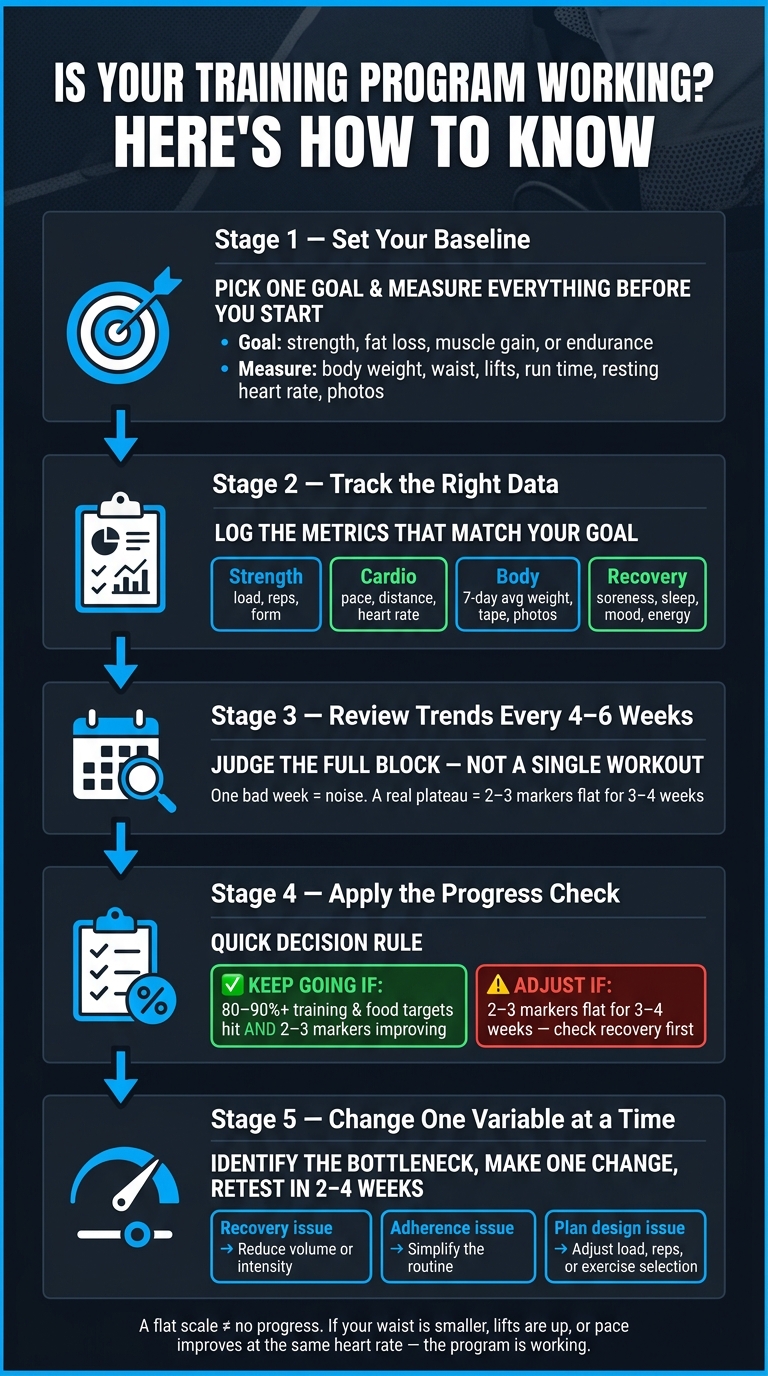
How to Tell If Your Training Program Is Working: A Step-by-Step Tracking System
Once you have a baseline, performance data tells you if your plan is pushing you in the right direction. It’s one of the clearest ways to tell whether your program is doing its job. If your lifts, pace, or effort get better over 4–6 weeks, you’re moving forward.
After each session, log:
That extra context matters. It helps you spot patterns and make sense of a dip or a big day. And yes, timing matters here too - log it right after training while it’s still fresh.
Look at trends every 4–6 weeks, not workout by workout. One rough session is just noise, not failure. The point is to judge the full block, not a single day.
Use your log to watch two main performance signals: strength and endurance.
Strength gets better when you lift more weight, do more reps, or handle the same load with better control. Even small jumps matter. Adding 2.5–5 pounds to a compound lift counts as small but meaningful progress.
Movement quality matters too. A deeper squat, cleaner reps, or less grinding all count. Write that down in your log. Over 4–6 weeks, those small technical gains often lead to bigger lifts.
For cardio, the idea is the same: compare the same test under the same conditions. If you can do the same route at the same pace with a lower heart rate, your endurance is getting better. That’s a direct sign the plan is working.
Retest a simple benchmark every 6–8 weeks, like a 1-mile walk or run, a repeat 3-mile route, or a 5K. Keep the conditions the same each time. When you compare heart rate and pace across two test dates, you get a clear, objective read on whether your endurance is improving.
If your performance is getting better but the scale feels all over the place, body composition gives you a better read on what’s changing. The scale still helps. It just shows more than fat change, so treat it as one signal, not the final answer.
The best move is to use three checks together: weigh-ins, tape measurements, and photos. Each one fills in a gap the others miss.
Weigh yourself daily under the same conditions and look at a 7-day average. Take tape measurements every 2–4 weeks. Take progress photos every 4–6 weeks. Used together, these checks make it much easier to tell the difference between actual fat loss or muscle gain and short-term water shifts.
If body composition is improving but your energy is dropping, recovery is the next thing to look at.
If you want more precise data on fat mass and lean mass, use DEXA every 3–6 months.
For most people, weekly weight averages, tape measurements, and photos are enough. If you want a more precise check from time to time, add DEXA.
Once body composition starts moving in the right direction, the next step is to see whether the program still supports recovery and consistency.
Once your performance and body composition start moving in the right direction, recovery becomes the next thing to watch. A program only works if it helps you get better without messing up your recovery, sleep, mood, or ability to stay consistent.
Low soreness and high workout completion are two of the clearest signs that your plan is sustainable. In a well-structured program, muscle soreness should fade within 24–48 hours. If you're still so sore that you can't move well two days after training, that's a sign to cut volume or intensity in the next block, not grit your teeth and force it.
Consistency matters just as much. It doesn't just reflect progress - it helps create it. At the end of each week, calculate your completion rate:
workouts completed ÷ workouts planned
Aim for 90–100% before making the program harder. If you're missing sessions again and again because you're run down, that's a stronger signal to pull back than any one lift, pace, or rep count.
This doesn't need to be fancy. In your training log, score fatigue, session quality, mood, and sleep quality on a 1–10 scale each day. If those four numbers stay steady or trend up, your program is likely supporting recovery. If they stay low for several days, take the hint and add a rest day or deload.
Short notes help too. A line like "felt strong today" or "slept 5 hours, scaled back squats" gives context to the numbers. Over time, those notes can show patterns that raw scores alone might miss.
Your day-to-day ratings can tell you a lot, but clinical testing can give you a deeper look at cardiovascular fitness, recovery, and metabolic health. VO2 max testing, metabolic testing, and blood panels can help you check whether your long-term markers are moving in the right direction as your training changes.
Use them as periodic checkpoints:
That way, you're not just seeing whether the program works in the short term. You're checking whether it still makes sense over time.
One of the simplest objective markers you can track right away is resting heart rate. Measure it before you get out of bed. If it suddenly jumps by 5 or more beats above your personal average, that's often a sign your body is still recovering. In that case, the day's session may need to be lighter than planned.
Use these recovery signals before deciding whether to stick with the plan or adjust it.
Look at your logs, measurements, and recovery scores together. That side-by-side view helps you decide if you should keep going or make a change. It also helps you tell the difference between actual progress, a false alarm, and a legit plateau.
One bad week doesn't mean much. That's just noise. A slow workout might come down to poor sleep or high stress.
A real plateau sticks around. It usually means 2–3 key markers - like strength, measurements, and photos - show no meaningful change for 3–4 weeks, even though you've been consistent with training, sleep, and nutrition.
Start by checking adherence. If you haven't hit at least 80–90% of your planned sessions and nutrition targets over the last month, the problem may be execution, not the program.
And here's an easy example of why context matters: a flat scale with a smaller waist is still progress, not a stall.
If adherence is high and progress is still flat, change one variable at a time. That's the key. If you switch exercises, add load, and shorten rest periods all in the same week, you won't know what made the difference.
Use your data to spot the bottleneck:
| Bottleneck | Data Indicators | Recommended Adjustment |
|---|---|---|
| Recovery | Low energy, persistent soreness, poor sleep | Reduce training volume or intensity; improve sleep and nutrition |
| Adherence | Missed sessions, inconsistent workout times | Simplify the routine; shorten workout duration |
| Plan design | Consistent effort but no performance gains | Adjust load, reps, or exercise selection |
After you make a change, stick with it for 2–4 weeks before you retest your benchmarks. Keep the test conditions the same too - same time of day, same equipment. That way, you're comparing apples to apples.
A program is working when your data trends the right way over time, not just on a good day.
That starts with a clear goal and a baseline. From there, track performance through load, pace, and reps. Measure body composition with more than just the scale. Watch recovery and health markers from week to week.
If progress stalls, review a few weeks of data across more than one marker. Check adherence first. Then make one focused change and retest.
The right program moves you toward one specific goal in a measurable way. The data shows it.
A steady scale reading doesn't always mean your training program has hit a wall. You could be losing body fat and adding lean tissue at the same time, which keeps your body weight about the same even while your shape changes.
So instead of judging progress by the scale alone, look at a few other signals:
Weekly weight averages can also help smooth out normal day-to-day swings.
Match each retest to how fast that metric tends to change.
After every session, log your strength, reps, and workout consistency. Then, once a week, look back at your energy, sleep quality, and how many workouts you finished.
Check body composition markers, progress photos, and performance benchmarks every 4 weeks. For deeper assessments, like DEXA scans, space them out to every 3 to 6 months.
Before you blame your training program, make sure the plateau is actually a plateau. Check whether your load and volume have stayed flat for multiple weeks. If your tracking is patchy, you might miss progress that’s still happening.
If your tracking is solid and progress still isn’t moving, start with the basics: recovery, sleep, and nutrition. Those are often the first places things go sideways.
Only after that should you tweak the plan. And keep it small. Change one variable at a time so you can see what’s doing the work, such as:


.svg)
