Don’t start with a random lab panel. Start with your goal. If you want to check blood sugar, heart risk, or the cause of fatigue, the right markers are different. That one step can help you avoid wasted tests and focus on numbers that may matter more.
Here’s the short answer:
A few details can change what I’d test next. For example, metformin can lower B12 in 6%–30% of users. Hard training in the prior 24–48 hours can shift hs-CRP, creatine kinase, ALT, and AST. And biotin should usually be stopped for 48–72 hours before thyroid or hormone testing.
If I were choosing tests, I’d keep it simple: pick the goal, match the lab category, add symptom-based markers, then track the same markers over time.
| Focus | Good starting markers | Why they help |
|---|---|---|
| Blood sugar / weight | Fasting insulin, HbA1c, HOMA-IR, triglycerides, HDL | Can show insulin resistance before glucose gets high |
| Heart risk | ApoB, Lp(a), lipid panel, hs-CRP | Shows particle-related risk and inflammation |
| Fatigue / recovery | CBC, ferritin, TSH, Free T4, vitamin D, B12, folate | Checks for anemia, thyroid issues, and low nutrient levels |
That’s the framework: test for a reason, keep the list tight, and compare results over time instead of guessing from a single number.
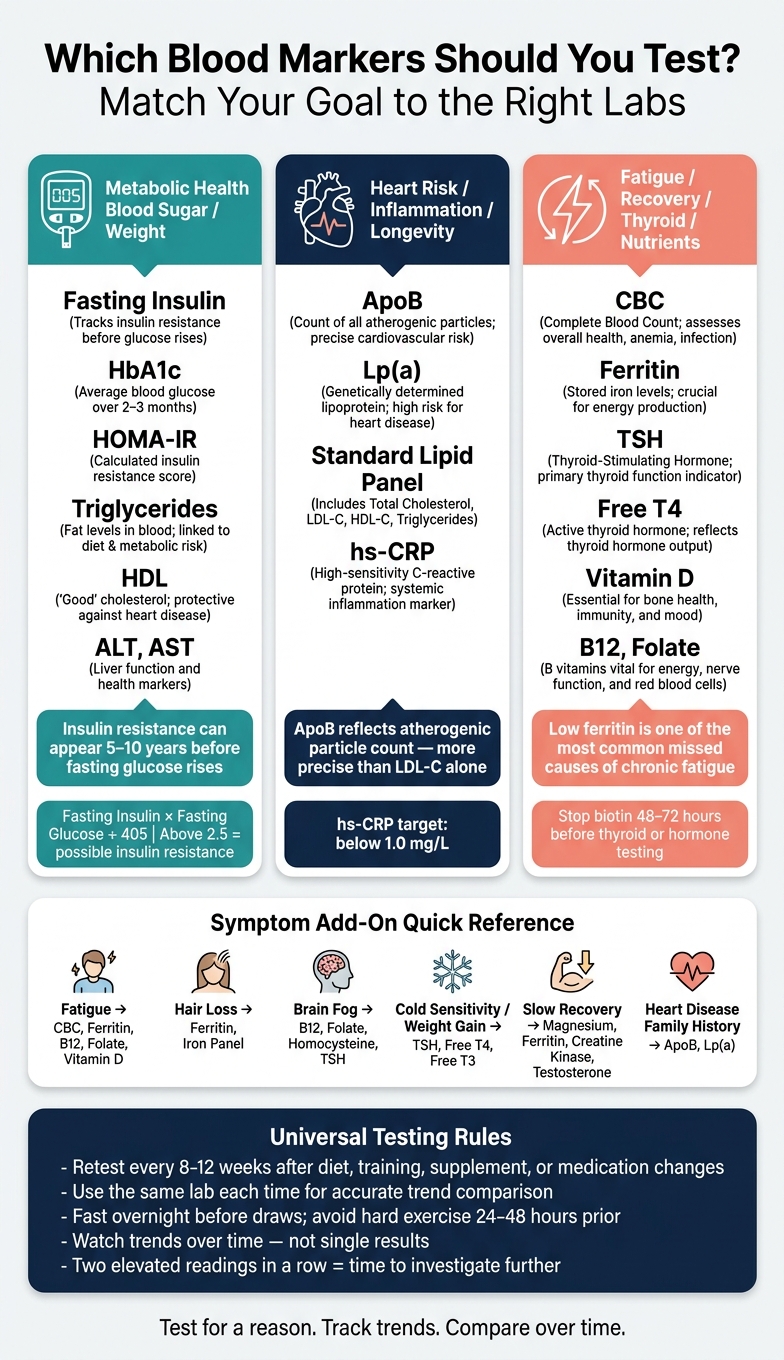
Blood Markers to Test by Health Goal: A Quick Reference Guide
Once you know your goal, line it up with the right group of markers. Not every lab category fits every goal. Pick the wrong tests, and you add cost without getting much useful signal.
If you're focused on glucose, body weight, or metabolic risk, fasting insulin and HOMA-IR can help spot issues early. Insulin resistance can show up 5 to 10 years before fasting glucose starts to climb, and HbA1c shows your average blood sugar control over about 3 months.
To calculate HOMA-IR, multiply fasting insulin (µIU/mL) by fasting glucose (mg/dL) and divide by 405. A HOMA-IR above about 2.5 often points to insulin resistance. A fasting insulin below 5.0 µIU/mL is generally a good sign.
It also helps to add triglycerides, HDL, ALT, and AST. These can show how metabolic strain is affecting the body.
For heart risk, begin with a standard lipid panel. Then go a step further with ApoB. It's more precise than LDL-C because it reflects the number of atherogenic particles.
Lp(a) is worth checking at least once because it is mostly genetic. Add hs-CRP to look at systemic inflammation. A common target is below 1.0 mg/L.
Fatigue can come from a lot of places, and blood work is one of the fastest ways to narrow things down. CBC and ferritin help check for anemia and iron status. Low ferritin is one of the most common and most missed causes of long-term tiredness, even when standard iron markers look normal.
Pair those with TSH, Free T4, and in some cases Free T3. Then add nutrient markers like vitamin D, B12, and folate to sort through common causes of low energy and poor recovery.
One small but important detail: stop biotin for 48 to 72 hours before testing. It can distort thyroid and hormone results.
In practice, these are the most useful starting markers by goal.
| Goal | Primary Markers | What They Reveal |
|---|---|---|
| Metabolic health | Fasting insulin, HbA1c, HOMA-IR, triglycerides, HDL | Insulin resistance and glucose dysfunction before diabetes onset |
| Heart risk | ApoB, Lp(a), standard lipid panel, hs-CRP | Cardiovascular risk and inflammation |
| Fatigue & recovery | CBC, ferritin, TSH, Free T4, vitamin D, B12, folate | Anemia, thyroid dysfunction, and nutrient gaps |
Use this table as a starting map. From there, your symptoms, age, medications, and training load help narrow the final list.
Your goal helps you pick the right category. Your symptoms and health history help you pick the right tests within that category.
Symptoms can point you toward a few targeted add-ons. Fatigue may call for CBC, ferritin, B12, folate, and vitamin D. Hair loss or pale skin can point to ferritin and an iron panel.
The key is simple: use these add-ons to shrink the list, not make it spiral.
| Symptom | Add-on Tests to Consider |
|---|---|
| Fatigue / low energy | CBC, Ferritin, Vitamin B12, Folate, Vitamin D |
| Hair loss / pale skin | Ferritin, Iron Panel |
| Brain fog / memory issues | B12, Folate, Homocysteine, TSH |
| Cold sensitivity / weight gain | TSH, Free T4, Free T3 |
| Palpitations | Potassium, Sodium, red blood cell magnesium |
| Slow recovery after training | Magnesium, Ferritin, Creatine Kinase, Testosterone |
| Joint pain / chronic illness | hs-CRP |
| Family history of heart disease | ApoB, Lipoprotein(a) |
A few personal details often change the list more than people expect.
If you're an endurance athlete and your recovery feels slow, it makes sense to watch ferritin, iron, and magnesium. Timing matters too. Try not to do your blood draw within 24 to 48 hours of a hard workout, since heavy training can temporarily spike hs-CRP, creatine kinase, and liver enzymes. That can make your results tougher to read.
If you take metformin, keep an eye on B12. Long-term use lowers B12 in 6% to 30% of users.
And with hormone markers like estradiol, FSH, and LH, more isn't always better. These tests tend to make the most sense when symptoms are part of the picture, like shifts in energy, mood changes, or libido concerns. They aren't default tests for everyone.
Once you've nailed down the add-ons, the next move is deciding whether they fit into a broad baseline or a focused follow-up panel.
Once you’ve narrowed down the markers, the next call is simple: do you need a starting snapshot or a targeted recheck?
Go with a broad panel when you need a starting point. That first round gives you a baseline, and later labs show whether things are moving the way you want.
This route fits best if you’ve never had broad bloodwork done before, if you’re making a major diet or training shift, or if you have several symptoms that overlap and don’t clearly point to one body system. It can also flag insulin resistance that fasting glucose alone may miss. And if you want more context, you can pair broad bloodwork with DEXA, VO2 max, or metabolic testing.
That’s what makes the baseline so useful: later comparisons mean a lot more when you know where you started.
For follow-up testing, keep it narrow. Recheck the markers tied to the goal you’re tracking.
For example:
In most cases, wait 8 to 12 weeks before retesting. That gives your body enough time to show actual physiological change instead of normal day-to-day swings. HbA1c, for example, usually needs at least 2 to 3 months to shift in a meaningful way.
When the next set of labs comes in, look for trends, not just one-off numbers.
| Broad Baseline | Focused Follow-up | |
|---|---|---|
| When to use | First check, major diet or training change, vague or overlapping symptoms | 8–12 weeks after starting a new diet, medication, or supplement protocol |
| Example markers | CBC, HbA1c, fasting insulin, ApoB, hs-CRP, vitamin D, TSH | HbA1c + fasting insulin (glucose goal), ApoB + triglycerides (heart risk) |
| Use case | Establishing a reference point, catching hidden risks | Confirming whether a specific intervention worked |
| Main limitation | Higher upfront cost; may surface results that need context | Can miss issues in systems you’re not actively watching |
Then compare the results with your symptoms and earlier labs to decide what to recheck next.
Look for patterns over time, not one-off numbers. Reference ranges can include healthy outliers, so a single result often matters less than the direction things are moving. Even a small upward drift can mean something. For example, fasting glucose moving from 82 to 99 mg/dL over three years, or hs-CRP rising from 0.3 to 0.8 mg/L, may point to a real change even if both values still sit inside the lab’s normal range.
One odd result can just be noise. But if you see two elevated readings in a row, that’s a good time to look closer. It also helps to compare those lab trends with body-composition testing and fitness data. That way, you can tell whether a shift reflects actual physiology or just random variation.
Blood work makes more sense when you pair it with DEXA, VO2 max, and metabolic testing. Those assessments can show whether a lab change lines up with body composition, fitness, or metabolic strain.
Say a marker changes and your DEXA also shows a shift in body fat, or your VO2 max drops at the same time. That gives the number more meaning. It also helps narrow down what to retest instead of repeating everything.
If trends get worse or stay high, bring in a clinician. The markers most worth following over time are:
When you’re making changes, like adjusting your diet, starting a supplement, or changing training, retest every 8–12 weeks. Once things level off, a yearly recheck is usually enough.
Try to use the same lab each time. Different equipment and testing methods can make a real change look like lab noise. Keep your prep the same too:
Clearly abnormal findings, or markers that stay high after 3–6 months of lifestyle changes, should be reviewed by a clinician. Check Lipoprotein(a) once, then keep that result for long-term risk planning. For everything else, recheck the markers tied to your goal, and move up to clinical review if they stay abnormal after repeat testing.
Yes - broad panels are a good place to start when you use them with a clear purpose. A full yearly panel can give you a solid baseline for organ function and overall health.
After that, shift to targeted testing based on what you’re trying to track. If you’re watching one issue, test that smaller group every 3 to 6 months instead of paying for the same broad panel again and again. And if you can, stick with the same lab so your results are more consistent.
Yes. Fast for 10 to 12 hours before glucose, insulin, or lipid tests. Water is allowed.
Also, skip intense exercise for 48 hours before your blood draw. And if you can, try to stay healthy and well-rested for 5 to 7 days beforehand so inflammation or cortisol spikes don’t skew the results.
For most people, one annual panel is enough to set a baseline and keep an eye on long-term health.
If you're making active changes to your lifestyle, diet, or supplements, it makes sense to test again every 3 to 6 months. That gives you enough time to see how your body is responding and whether your plan needs a tweak.
For specific nutrients or metabolic markers, wait at least 8 to 12 weeks before retesting. Testing too soon can muddy the picture.
A couple of practical things matter here too:


.svg)
