Most people do not need blood work every year. If I’m healthy and under 40, testing every 1 to 3 years is often enough. If I’m 40+, on new medication, treating a deficiency, or tracking a health issue, I may need labs every 3 to 12 months instead.
Here’s the short answer:
A single test shows one moment. A trend shows direction. That’s why timing depends on age, symptoms, past results, family history, medications, and what I’m trying to measure.
Before any retest, I’d also keep timing in mind:
Bottom line: the best blood test schedule is the one based on risk, timing, and repeat results - not guesswork.
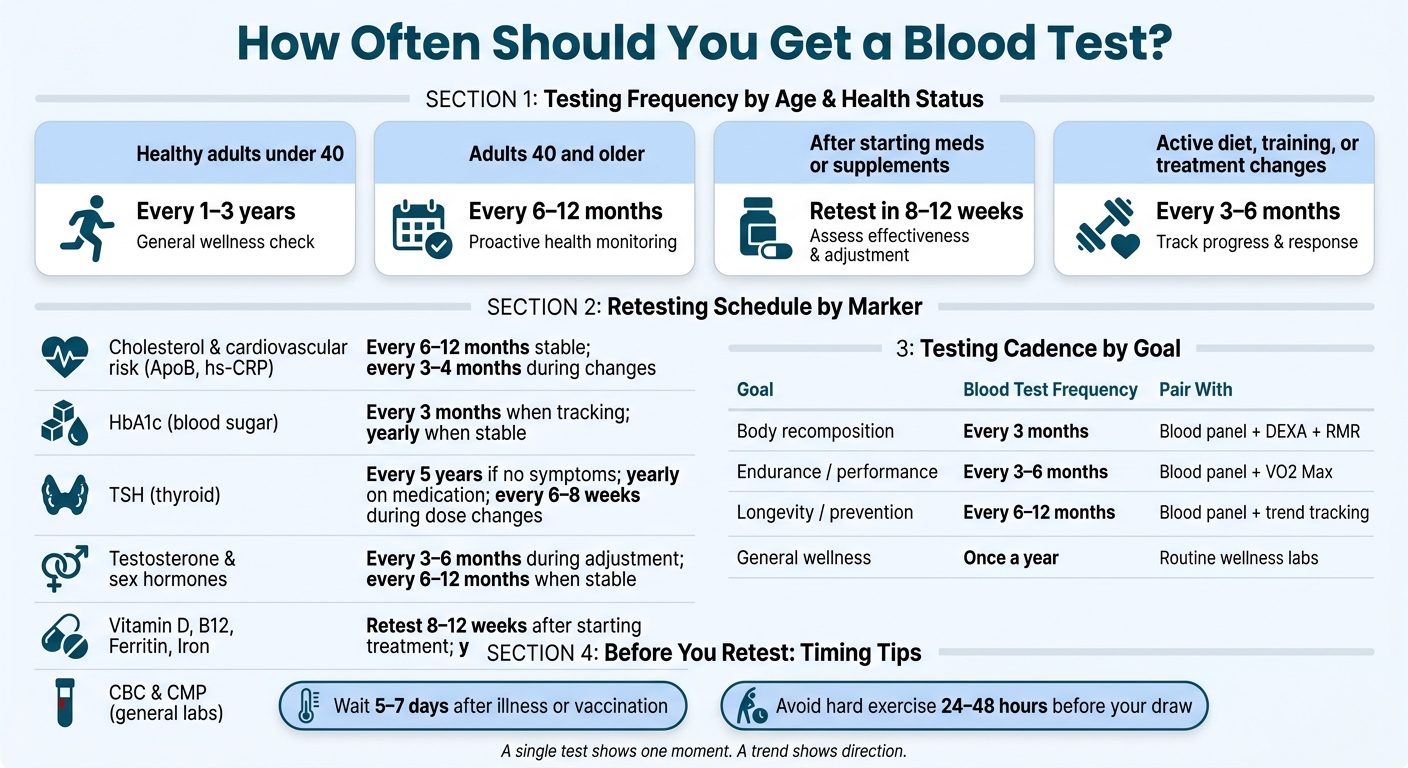
How Often Should You Get a Blood Test? Frequency by Age & Health Goal
If you're under 40 and in good health, you usually don't need a full blood panel every year. A baseline set of labs in early adulthood, then repeat testing based on your risk factors, symptoms, and past results, is often enough.
That’s because results in this age group tend to shift slowly. So unless something changes with your health, there’s usually no need to recheck every marker every 12 months.
If diabetes runs in your family, or you have other risk factors, fasting insulin can give added context when glucose and HbA1c still look normal.
After 40, yearly testing often makes more sense. Cardiometabolic risk can creep up over time without obvious symptoms, and one normal result doesn’t tell the whole story.
What matters more is the trend. Annual labs can help spot slow changes early, before you feel anything is off.
In the U.S., common yearly preventive labs include:
For heart and metabolic risk, ApoB, hs-CRP, and fasting insulin can add more detail.
These age-based intervals are a starting point. From there, each marker may follow its own retesting schedule.
Routine labs give you a baseline. But some markers need a different retesting schedule, especially if you're tracking change instead of just doing a once-a-year screen.
Once your results are stable, retesting every 6 to 12 months is usually enough. If you've changed your diet, exercise routine, or medication, give it 8 to 12 weeks before you test again. When you're in the middle of active changes, repeating labs every 3 to 6 months makes more sense.
HbA1c follows a similar pattern. It reflects about 2 to 3 months of blood sugar exposure, so testing every 3 months helps when you're trying to show change. Once your numbers are steady, annual testing is often enough.
If you're watching cardiovascular risk more closely, ApoB and hs-CRP are often checked on that same 6- to 12-month schedule. During active treatment or lifestyle changes, they're often repeated every 3 to 4 months.
If your TSH is normal and you don't have symptoms, rechecking every 5 years is usually fine. If you're on thyroid medication, test yearly once your dose is stable, and every 6 to 8 weeks during dose changes.
Testosterone and other sex hormones are usually checked at baseline, then every 3 to 6 months while treatment is being adjusted, and every 6 to 12 months once things settle down.
For vitamin D, B12, ferritin, and iron, retest 8 to 12 weeks after starting treatment. After that, yearly testing is usually enough once levels are stable.
For general monitoring, broader panels help cover the safety checks between more targeted tests. For most healthy adults, a CBC and CMP every 6 to 12 months is enough.
You may need to repeat them sooner after:
It also helps to use the same lab for repeat testing. Different equipment and reagents can lead to small variations, and that can muddy the picture when you're trying to compare results over time.
Repeating labs makes the most sense when something has changed. That could mean starting or changing a medication, taking a targeted supplement for a documented deficiency, or beginning a new diet or exercise plan.
New or stubborn fatigue, weakness, or fever also calls for prompt blood work, often starting with a CBC. Slightly abnormal results can be a good reason to test again too, since a follow-up can show whether the shift was temporary or more persistent. Once you know your baseline schedule, the next step is figuring out when it makes sense to move that retest up.
Timing matters just as much as the reason. You need to wait long enough for the change to show up in the labs. In plain English: retest sooner only for markers that move fast, and give more time to markers that change slowly.
A couple of timing rules help keep results from getting muddy:
That trend view is what turns repeat testing into a plan you can actually use.
A single blood draw shows where you were on one day. It does not show where you're headed. Hydration, stress, a recent workout, fasting status, or even altitude can move numbers up or down for a short time. One result can be noise. Two or three start to show the pattern.
Serial testing helps you tell the difference between a real change and normal day-to-day variation. When you compare results across several draws - and log things like fasting status, recent illness, training load, medications, and supplements - you get the context that one test alone can't give you. That's what makes repeat testing useful instead of just comforting.
Use those trends to set your testing cadence in Benchmark Body Metrics.

If you’re already tracking trends, blood work makes more sense when you view it alongside functional testing. On its own, a lab result gives you a snapshot. Add body-composition and fitness testing, and you can see how your health is changing, not just where it sits today.
Here’s a good starting cadence:
| Goal | Blood Test Frequency | Pair With |
|---|---|---|
| Body recomposition | Every 3 months | Blood panel + DEXA + RMR |
| Endurance / performance | Every 3–6 months | Blood panel + VO2 Max |
| Longevity / prevention | Every 6–12 months | Blood panel + trend tracking over time |
| General wellness | Once a year | Routine wellness labs |
For body-composition goals, DEXA fills in a gap that why your scale is lying to you. If you’re losing weight, it can show whether that change is coming from fat or lean mass. That matters a lot. Two people can lose the same number of pounds and end up in very different places. Once your numbers level off, yearly testing is often enough.
A layered testing plan that combines blood work with functional assessments gives you the clearest view of change over time.
The best schedule is the one you can stick with and learn from. Start with a solid baseline, pair it with functional assessments when they fit your goal, and use the trend - not a single result - to guide your next move.
Yes - fasting is recommended before most blood tests so your results are as accurate as possible.
For the Benchmark Comprehensive Panel and most metabolic or cardiovascular screenings, fast for 8 to 12 hours before your blood draw.
During that window, drink water only. Avoid:
For a baseline health check, start with:
Taken together, these tests give you a solid snapshot of your health. They can show how your metabolism is working, flag signs tied to heart disease risk, point to inflammation, and show how well your body is handling blood sugar.
Just as important, they give you a starting point. That way, when you check again later, you can spot patterns and changes instead of looking at each result in isolation.
Yes. Poor sleep and stress can affect blood test results because they can cause short-term changes in biomarkers.
For example, lack of sleep may increase blood pressure, and chronic stress can affect cardiovascular health.
Physical activity, recent infections, and stress can all lead to fluctuations. So it helps to be healthy and well-rested for 5 to 7 days before your blood draw.


.svg)
