If you want a calorie starting point based on your body, RMR testing does that better than a formula. It measures how many calories you burn at rest by tracking oxygen in and carbon dioxide out. Most tests take about 20 minutes, and the result can help with fat loss, muscle gain, or weight maintenance.
Here’s the short version:
A few points are easy to miss. BMR, RMR, REE, and TDEE are not the same thing. And a measured RMR is only a starting point - you still need to factor in activity, training, and body-composition changes.
If I were reading this to decide whether the test is worth it, I’d focus on three things: what it measures, how to prepare, and how to use the number without overreading it.
| Term | What it means | What it includes |
|---|---|---|
| RMR | Resting metabolic rate | Calories burned at rest under test conditions |
| BMR | Basal metabolic rate | A tighter lab measure under stricter conditions |
| REE | Resting energy expenditure | A broad resting estimate |
| TDEE | Total daily energy expenditure | Resting burn plus activity, exercise, and digestion |
That’s the core idea of the full article: get the test under the right conditions, read the report the right way, and use the result as a baseline - not the whole answer.
Most calorie targets start with prediction formulas based on age, sex, height, and weight. That matters because your calorie target shapes every nutrition choice that comes after it. The problem is pretty simple: those formulas lean on population averages. They can’t account for your own physiology or how your body uses energy day to day. A measured RMR gives you a number based on you, not a general estimate built from your stats. That makes RMR useful when calorie intake needs to line up with a specific goal.
RMR is just one part of TDEE. The rest comes from activity, exercise, and digestion.
This becomes most useful when you’re making nutrition and training decisions. A lot of people get tested because they want a more accurate calorie baseline. If the goal is fat loss, muscle gain, or weight maintenance, a measured RMR cuts down on guesswork. It can show whether your resting burn is lower, higher, or about average for someone with stats like yours.
For athletes and active adults, that can make day-to-day planning much easier. Training volume changes calorie needs, and a bad baseline can lead to poor recovery or not enough fuel on hard training days. Knowing your actual resting burn gives you a clear place to start.
Prediction equations like the Harris-Benedict or Mifflin-St Jeor formulas are free and fast, but they come with a clear tradeoff: they assume you fit a standard profile. If you have a lot of muscle mass, or your metabolism has shifted after long periods of dieting, those estimates can be meaningfully off.
Measured RMR comes from clinical gas-analysis testing, not a formula.
| Feature | Measured RMR (Indirect Calorimetry) | Prediction Formulas (e.g., Harris-Benedict or Mifflin-St Jeor) |
|---|---|---|
| Method | Measures oxygen consumption and CO2 production via gas exchange | Mathematical equations based on population averages |
| Inputs | Real-time physiological data | Age, sex, height, and weight |
| Personalization | High; accounts for individual metabolic efficiency | Low; assumes a standard statistical profile |
| Limitations | Needs a 20-minute appointment and strict prep | Can be less accurate for people with high muscle mass or metabolic adaptations |
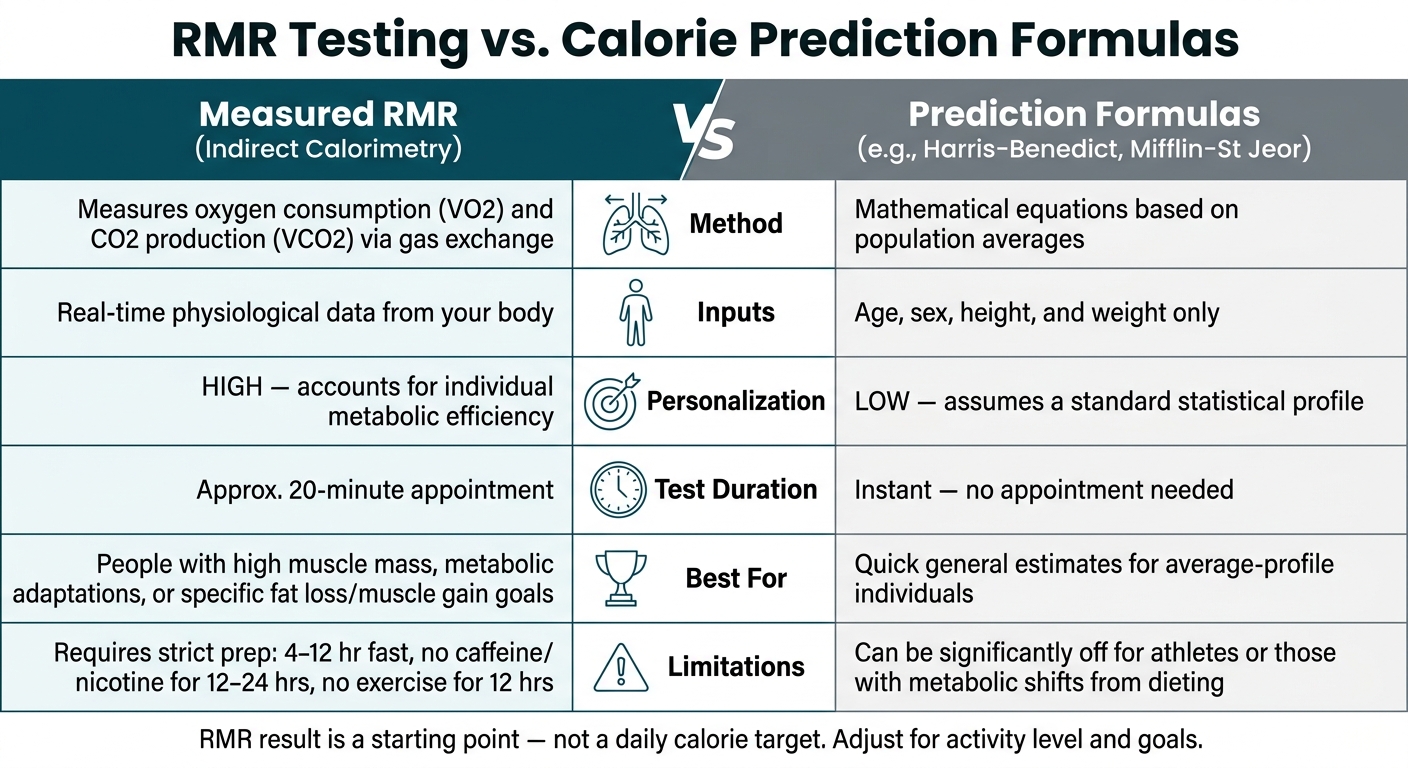
RMR Testing vs. Prediction Formulas: Which Is Right for You?
Once you know why this number matters, the next step is getting a clean measurement. RMR testing estimates resting calorie burn with indirect calorimetry. The exact test length and prep steps can change based on the device and the clinic's protocol. That's why strict prep matters so much: it helps keep the reading close to your actual resting state. If your provider gives you instructions that differ from general advice, follow their directions.
Indirect calorimetry looks at oxygen use (VO2) and carbon dioxide output (VCO2), then turns that data into an estimate of resting calorie burn. To do that, the test needs a snug mask or mouthpiece. Even small air leaks can throw off the reading. Many clinics use a mask setup similar to a CPAP mask, which measures gas exchange to calculate metabolic rate.
What you do in the hours before the test can change the result in a big way. Common prep instructions include:
| Preparation Factor | Guideline |
|---|---|
| Fasting | No calories for at least 4 hours; 12 hours is ideal |
| Exercise | Avoid all physical activity for at least 12 hours prior |
| Caffeine & nicotine | Avoid for 12–24 hours before testing |
| Medications | Continue all normally prescribed medications as usual |
| Hydration | Water is usually allowed during the fast |
It also helps to schedule the test in the morning. If you do a retest later, try to keep the same time of day and the same fasting pattern so the results are easier to compare.
Once your prep is done, the appointment itself is usually short and easy. It often starts with a brief check-in. Your provider may review your health history, ask about your goals, and note any medications or supplements you're taking, or discuss how this fits with other body composition testing methods.
After that, you'll sit back or lie flat while the measurement runs. This isn't a workout or a stress test. (If you are looking for performance data, you might also want to prepare for a VO2 max test.) The point is to get a steady baseline that can be repeated later. The measurement usually takes about 20 minutes. When it's done, your provider will review the results with you.
Once you have the report, pay attention to the fields that change how you set calories. You do not need to obsess over every number on the page.
Your RMR result is a snapshot of how many calories your body burned under the exact conditions of that test. It is not your daily calorie target. Think of it as a personal starting point.
Most RMR reports include more than one calorie number. Here’s what the main fields usually mean:
| Report Field | What It Measures | Why It Matters | How to Use It |
|---|---|---|---|
| Resting Calories/Day | Total calories burned at complete rest | Your measured calorie burn at rest | Use as a starting point for daily calorie targets |
| Measured vs. Predicted RMR | Your measured RMR compared to predicted norms for your age, sex, and body size | Shows whether your measured RMR is above, below, or close to formula-based estimates | Helps explain why standard calorie advice may not be working for you |
| VO2 / VCO2 | Oxygen consumed and carbon dioxide produced during the test | The raw gas exchange data used to calculate your calorie burn | Use to understand the inputs behind your calorie number |
| Respiratory Exchange Ratio (RER) | The ratio of VCO2 to VO2 | Shows the balance of fat versus carbohydrate being burned at rest | Adds context to your metabolic picture |
| Data Quality / Steady-State Indicator | Consistency of your breathing and heart rate during the test | Confirms the result reflects a true resting state, not a skewed reading | Helps validate that the number is reliable before you act on it |
| Testing Condition Notes | Fasting status, caffeine intake, time of day | Provides context for interpreting the result | Important for comparing results across multiple tests over time |
The RER gives you extra context by showing how your body is using fat and carbohydrates for fuel at rest. On its own, it won’t set your calories. But it can help you make better sense of the rest of the report.
Start with the quality fields, then use the calorie number. If the test data looks clean, your measured RMR gives you a solid read on what your body burns at rest.
From there, adjust for your activity level and your goal. That means using RMR as the base for maintenance, fat loss, or muscle gain instead of leaning only on a generic formula. It’s a bit like starting with your actual gas mileage instead of the sticker estimate on the car.
It also helps to pair RMR with body-composition data. That way, if your weight changes, you can see whether it came from fat, lean mass, or both.
No single test tells the whole story. RMR answers one specific question: how many calories does your body burn at rest? That’s useful, but it’s only one piece of the puzzle.
At Benchmark Body Metrics, RMR can be reviewed alongside DEXA, VO2 max, and blood panels for more context. Markers such as thyroid function, insulin, ApoB, or testosterone can help explain an unusual RMR result.
Before you act on the number, review the factors that can distort it.
Before you act on your number, check what might throw it off.
RMR accuracy depends on strict prep. Food, caffeine, nicotine, exercise, and stimulants can all skew results.
If you're doing repeat tests, keep the time of day and your eating schedule the same. That way, you're comparing apples to apples.
RMR results are for informational use, not diagnosis or treatment. Do not test during pregnancy. People with heart or respiratory conditions should get medical clearance first.
If you prepared for the test the right way, use the result as a baseline. If not, retest under the same conditions.
RMR works best as a starting point, not a standalone answer. Pair it with body composition tracking and cardiovascular fitness data to track progress over time.
Used this way, RMR testing can help guide smarter nutrition, training, and long-term health decisions.
No. RMR is the number of calories your body burns at rest.
Maintenance calories - also called Total Daily Energy Expenditure (TDEE) - cover more than that. They include your resting metabolism, digestion, and physical activity.
RMR results from Benchmark Body Metrics, paired with body composition data, can help you estimate a more accurate TDEE starting point than generic online calculators.
An RMR test is the most accurate way to measure your own metabolic rate. Instead of leaning on broad population averages, it estimates calorie burn based on your physiology.
Clinical-grade equipment cuts down a lot of the guesswork that comes with standard calculators. And if you want an even tighter number, pairing an RMR test with a DEXA scan can help build one of the most accurate Total Daily Energy Expenditure baselines available outside a clinical lab.
It’s generally a good idea to retest your RMR every 3 to 6 months so your health plan stays data-driven and you’re less likely to hit a plateau.
Regular retesting helps you adjust your calorie targets as your body composition and metabolic rate shift over time. A lot of people line it up with quarterly check-ins, which makes it easier to keep nutrition and fitness plans on track.


.svg)
